


Why Trust Is the Real Access Pass
Access gets you in the room. Trust gets you the real story.
Athletes operate under constant pressure. Cameras in their face. Deadlines ticking. Critics waiting. In that setting, generic questions get safe answers.
A study from the International Journal of Sport Communication found that athletes are 45% more likely to give detailed responses when they perceive the interviewer as respectful and prepared. Preparation signals care. Care builds trust.
Without trust, interviews turn into rehearsed scripts. With trust, they turn into insight.
Understand the Pressure First
Athletes Live in a Performance Bubble
Athletes are evaluated daily. Stats define them. Commentators judge them. Fans praise or criticize them in real time.
In that environment, one careless question can shut down openness.
Rick Saleeby once described interviewing a veteran player coming back from injury. Instead of asking about stats or timelines, he asked, “What went through your head the first night you tried to run again?”
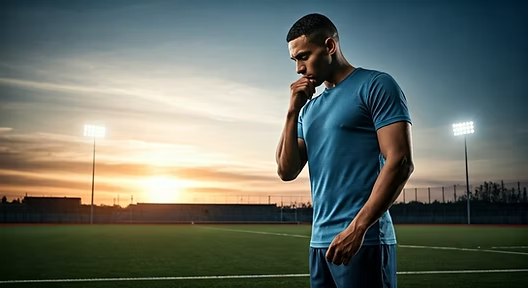
The player leaned back. He paused. He said he went to a high school track at night because he did not want anyone to see him struggle. He made it halfway around before pain forced him to stop. He sat in the grass and wondered if his career was done.
That answer came from trust. Not pressure.
Pressure Changes Behavior
Research from the American Psychological Association shows that high-pressure environments increase defensive communication patterns by up to 30%. That means athletes default to short, controlled answers.
The reporter must lower that defense.
Preparation Is Respect
Know More Than the Box Score
Preparation goes beyond stats. Know the backstory. Know the recent challenges. Know the milestones.
When an athlete sees that you did your homework, walls drop.
Saleeby once said, “If I ask a question they’ve heard ten times that day, I’ve already lost them.”
Preparation allows you to ask something different.
Study Body Language
Watch how athletes react to certain topics. Notice shifts in tone. Notice eye contact.
These signals tell you where comfort lives and where caution begins.
Respect those signals.
Ask Specific, Human Questions
Generic Questions Kill Trust
“How does it feel?”
“What does this win mean?”
These prompts invite rehearsed lines.
Replace them with:
- “What did your coach say in the huddle before that play?”
- “Who texted you first after the game?”
- “When did you start believing you could come back?”
Specific questions show curiosity. Curiosity shows care.
Give Space After Asking
Silence is powerful.
After asking a tough question, wait. Count to five. Let the athlete think.
In one post-game interview after a tough loss, a pitcher stared at the floor for twenty seconds before speaking. The camera stayed. No interruption. When he finally spoke, the honesty in his voice carried the segment.
Trust grows in quiet space.
Protect the Relationship
Accuracy Builds Credibility
Misquoting an athlete damages trust fast.
A Reuters Institute study found that audience trust drops by more than 35% after perceived inaccuracies. Athletes feel that impact too.
Double-check quotes. Confirm context. Clarify intent.
Accuracy shows professionalism.
Avoid Sensational Framing
Athletes know when a headline twists their words. That memory sticks.
If your framing creates drama that was not there, you trade long-term trust for short-term clicks. That trade rarely pays off.
Consistency Over Time
Trust Is Built in Small Moments
Trust does not come from one great interview. It comes from steady behavior.
Show up prepared every time. Follow through on promises. Respect off-the-record comments.
Over time, athletes notice.
Be Human
Athletes are people first. Ask about life beyond the field when appropriate. Remember details from past conversations.
One producer recalled asking a player about his daughter’s school play because he remembered the mention from months earlier. The player smiled before the interview even began. That smile changed the tone.
Small details matter.
Practical Steps for Journalists
- Research beyond stats before every interview.
- Prepare three specific, non-generic questions.
- Start with one question that signals empathy.
- Maintain eye contact and avoid constant note-checking.
- Allow silence to work instead of rushing.
- Verify quotes before publication.
- Follow up after stories air to maintain rapport.
These steps require effort. They create results.
The Competitive Advantage
High-pressure media environments are crowded. Reporters compete for time and sound bites.
Trust becomes the differentiator.
Athletes remember who treated them fairly. They remember who listened. They remember who asked about the night no one saw.
Trust unlocks deeper stories. Deeper stories create stronger engagement. Stronger engagement builds credibility.
Final Thoughts
Building trust with athletes is not about charm. It is about preparation, patience, and precision.
Athletes operate under scrutiny. Journalists who reduce that pressure, even slightly, earn access others do not.
Trust takes time. It requires consistency. It requires listening more than speaking.
When trust exists, interviews move beyond rehearsed lines. They reveal doubt, fear, belief, and growth. That is where the strongest stories live.
In high-pressure environments, trust is not optional. It is the foundation.
