


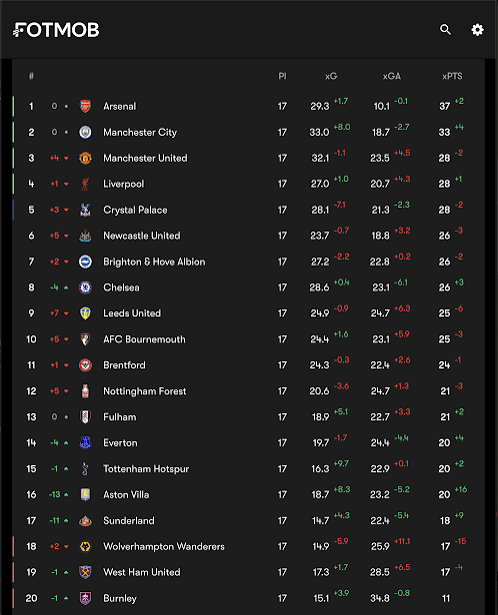
Expected goals (xG) and expected goals against (xGA) offer a clearer view of team performance than final scores. During the 2017/18 Premier League season, these metrics exposed patterns that traditional statistics often hid. For bettors, understanding how to read xG and xGA in a practical way creates a more stable foundation for decision-making.
What xG and xGA Actually Represent
xG measures the quality of chances a team creates, while xGA reflects the quality of chances it allows. Together, they describe how a team performs both offensively and defensively beyond the randomness of finishing.
This matters because goals can fluctuate due to luck, but chance quality tends to remain more consistent. By focusing on xG and xGA, bettors shift attention from outcomes to processes, which are more reliable over time.
Why These Metrics Improve Betting Accuracy
Traditional stats like goals scored can be misleading when finishing efficiency is unusually high or low. xG corrects this by showing whether a team’s scoring aligns with the chances it creates.
A team scoring more than its xG may be overperforming, while one scoring less may be underperforming. These gaps often lead to future corrections, creating opportunities when markets focus too heavily on recent results.
Identifying Strong and Weak Teams Through xG Balance
The relationship between xG and xGA reveals whether a team is structurally strong or vulnerable. Teams with high xG and low xGA tend to control matches, while the opposite indicates instability.
To interpret this balance effectively, consider the following patterns:
- High xG and low xGA, indicating dominance and consistent control over matches.
- High xG and high xGA, suggesting open games with higher volatility.
- Low xG and low xGA, reflecting defensive teams with limited attacking output.
- Low xG and high xGA, showing teams struggling on both ends of the pitch.
These profiles help categorize teams beyond league position, allowing bettors to anticipate match dynamics more accurately.
When xG and Actual Results Diverge
Differences between xG and actual results often signal future changes in performance. However, not all gaps are equal.
Variance vs Structural Problems
A team underperforming its xG may simply be experiencing poor finishing, which tends to improve over time. In contrast, a team with low-quality chances may appear to have decent xG but still lack sustainable attacking strength.
Recognizing this distinction prevents overestimating teams that are statistically active but tactically inefficient.
Applying xG Data to Match Analysis
xG becomes most useful when applied at the match level rather than season averages alone. Comparing two teams’ profiles reveals how their strengths and weaknesses interact.
A practical approach includes:
- Comparing each team’s average xG and xGA to assess overall balance.
- Evaluating whether one team’s attacking strength matches the opponent’s defensive weakness.
- Identifying whether the match is likely to be controlled or open based on both profiles.
- Adjusting expectations based on recent consistency in these metrics.
This process turns abstract numbers into concrete expectations.
How Markets React to xG Trends
Markets do not always fully incorporate xG data, especially when recent results contradict underlying performance. This creates temporary inefficiencies.
A noticeable pattern appears when observing odds through a digital betting interface such as ยูฟ่าเบท. Teams with poor recent results but strong xG metrics often carry longer odds than their actual performance suggests. This gap allows bettors to act before the market fully corrects.
Using xG Across Different Betting Types
xG analysis is not limited to predicting match winners. It also provides insight into goal-related markets and other betting formats.
Within a casino online environment that offers multiple wagering options, xG can guide decisions beyond basic outcomes. For example, matches involving two teams with high xG and xGA profiles may be better suited for over-goal markets, while balanced teams may favor more conservative selections. This expands the usefulness of xG into a broader strategic tool.
When xG Fails to Predict Outcomes
Despite its strengths, xG has limitations. It does not account for individual finishing skill, tactical adjustments, or psychological factors.
A deeper look at failure cases shows common risks:
- Teams with elite finishers consistently outperforming xG without regression.
- Tactical setups that generate low-quality chances but still produce goals through specific patterns.
- Matches influenced by early goals, altering game flow and shot quality.
- Defensive errors that are not fully captured in xGA models.
These factors highlight the importance of combining xG with contextual analysis rather than relying on it alone.
Turning xG Into Practical Betting Insight
The value of xG lies in how it is applied. By focusing on patterns rather than isolated matches, bettors can identify trends that persist over time.
This includes tracking teams that consistently outperform or underperform expectations, recognizing when those patterns are likely to continue, and adjusting decisions based on both data and context.
Summary
xG and xGA provide a clearer understanding of team performance in the 2017/18 Premier League by focusing on chance quality rather than results. When used correctly, they reveal hidden strengths, expose misleading outcomes, and highlight opportunities where market perception lags behind reality. By combining these metrics with situational awareness, bettors can make more informed and consistent decisions.
