


Summer projects pile up heavy things a shop has no way to lift
Through the busy summer months, home shops and small garages take on engines, gearboxes, and machinery that are simply too heavy to lift by hand, and the tool that answers when there is no beam overhead is a gantry crane.
It stands on its own legs and rolls to the load, so a shop gains a lifting point without building anything into the roof.
It is a bridge on legs that carries its own overhead
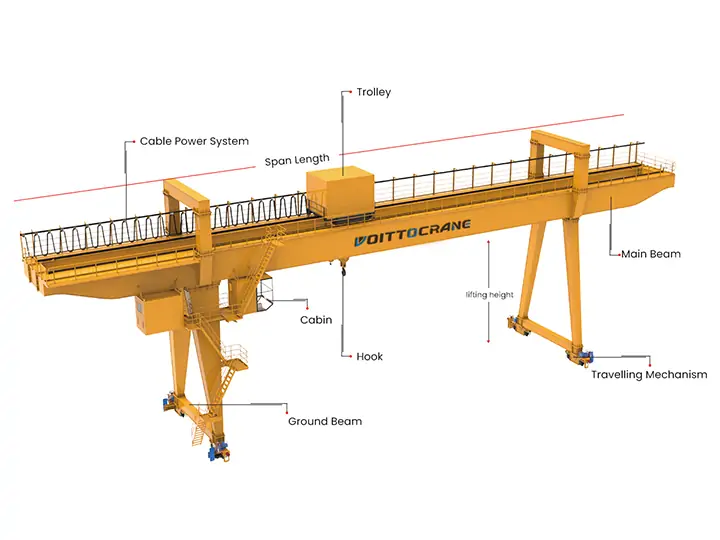
The frame is a horizontal top beam held up by two A-shaped legs, and a hoist hangs from that beam to do the actual lifting.
A gantry crane is really a portable version of the overhead crane a large plant builds into its structure, folded down to something one shop can own.
The value is bringing the hook to the work, anywhere
A fixed hoist forces the work to come to it, which is impossible with an engine block or a loaded pallet.
Rolling the frame over the load instead means the lift happens where the job already sits, in the bay, over the bench, or beside the truck.
The load runs a straight path from hook to floor
Weight on the hook travels up into the top beam, out to the two legs, and down through the casters into the floor.
Every part of a gantry crane is sized for that path, so the beam resists bending while the legs and casters carry the weight straight down.
Rated capacity assumes the load hangs where it should
The twenty-two hundred pound rating holds when the hoist pulls straight down from the middle of the beam, not off to one side.
Dragging a load sideways or hanging it near a leg loads the frame in a way the rating never promised, which is how a crane gets bent.
Adjustable height is what lets one frame fit many jobs
The legs telescope, so the same crane clears a raised truck bed one day and ducks under a low garage ceiling the next.
Setting the beam just high enough for the lift keeps the load low and the whole frame steadier than running it at full height for no reason.
The beam is the working span, and its length sets the reach
The length of the top beam is the distance a load can travel side to side, and it fixes how much of a bench or a bay one setup can serve.
A longer beam covers more ground but flexes more under the same weight, which is why a gantry crane is rated for a beam at a stated length rather than any length.
A wider stance is steadier but slower to move
The A-legs spread to a footprint, and a wider base resists tipping when a load swings, at the cost of fitting through a narrow doorway.
Choosing the stance is a trade between stability on the shop floor and getting the frame where it needs to go.
The hoist is matched to the crane, never grabbed at random
The beam only lifts what hangs from it, so the hoist and its rating are chosen to sit within the frame capacity, never above it.
A trolley that rolls along the beam lets the hoist track a load across the span instead of only straight up and down.
A chain hoist trades speed for control on a heavy pick
A hand chain hoist lifts slowly, but that slowness is control, letting an operator ease a gearbox onto its studs a link at a time.
For a home shop that lifts now and then, that deliberate pace is safer than a fast powered pull nobody needed.
The floor under the frame matters as much as the frame
Casters concentrate the whole load onto small contact points, so a sound, level concrete floor is what a gantry crane really stands on.
A cracked slab, gravel, or a sloped driveway lets a caster drop or drift, and a loaded frame that moves on its own is the hazard to avoid.
It comes apart to store and to travel
The frame bolts together from a beam and two legs, so it knocks down to flat pieces that fit along a wall or in a truck bed.
That break-down is part of the point, since a lift used a few times a month should not eat a whole bay standing assembled.
The bolts at the leg joints are the connection that carries the whole load, so they are checked tight before the frame ever takes weight again.
The plate on the leg is the last word before a lift
Every frame carries a rating plate, and reading it before an unfamiliar load is the habit that separates a long service life from a bent beam.
When a pick feels close to the limit, the safe answer is a bigger frame, never a hopeful pull on this one.
Casters make it mobile, and that is also its main caution
Locking swivel casters let one person roll the frame into place and then pin it still before the load goes up.
A shop owner near Columbus who rolled a loaded frame across a cracked floor learned to move the crane empty and lift only once it was parked and locked.
A crane under load is a discipline, not just a tool
The rating is a ceiling, not a target, and the load stays low and centered while the casters are locked before it ever leaves the ground.
Nobody stands under a raised load or reaches through the frame, since a shifting hoist and a heavy part leave no room for a second mistake.
Gantry, engine hoist, and overhead crane each fit a different shop
•Engine hoist: a wheeled arm for pulling motors
•Gantry crane: a portable span for general lifting
•Overhead crane: built into a building for daily use
Where a portable span wins and where it asks for care
•Strength: a lifting point with no roof structure
•Strength: rolls to the work and adjusts in height
•Limit: wants a flat, sound floor to roll on
•Limit: rated for straight lifts, not side pulls
Weighed against building an overhead beam, the portable frame trades some capacity and permanence for the freedom to lift wherever the work lands.
Small shops are buying capability they can roll away when done
As home shops take on heavier work, owners increasingly want lifting they can set up for a job and store in a corner afterward.
That pull toward flexible capability is why the shop lifting equipment that TMG Industrial builds folds real lifting power into a frame a single garage can keep.
