


Most people picture divorce as a courtroom. Two lawyers, a judge, testimony, a decision handed down. That picture comes from television, and it describes the least common way these matters actually conclude.
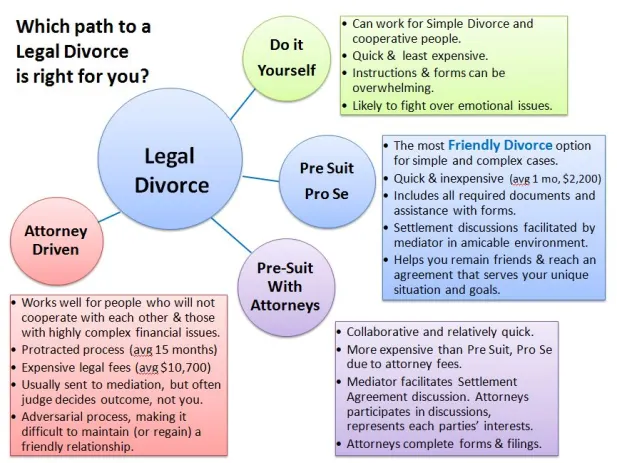
The great majority of divorces are resolved by agreement rather than by a judge, and there are several distinct paths to that agreement. They differ in cost, in timeline, in how much control the parties keep, and in how the relationship between them is likely to look afterward. Knowing what the options are before choosing one is worth a great deal, particularly for anyone who will still be sharing parenting responsibilities for years.
What follows is general information about how these processes work. It is not legal advice, and how any of it applies to a particular situation is a question for an attorney licensed where you live.
Uncontested Divorce
An uncontested divorce is one where the parties agree on everything that needs deciding: how property and debts are divided, how any spousal support is handled, and, where children are involved, custody, parenting time, and child support.
Because the terms are agreed, the process is largely a documentary one. The agreement is drafted, the paperwork is prepared and filed, and the court reviews it.
This is generally the fastest and least expensive route, which makes it attractive. The important caution is that agreement on the broad strokes is not the same as agreement on the details, and terms drafted without proper attention can create problems years later that cost far more to fix than they would have cost to get right. Even where a couple agrees entirely, having the agreement reviewed by an attorney is a small expense against what an ambiguous provision can cost later.
Mediation
Mediation involves a neutral third party who helps both spouses reach agreement. The mediator does not represent either person and does not decide anything; the role is to structure the conversation, identify what needs resolving, and help the parties work through it.
It suits situations where the parties can communicate reasonably, where there is broad willingness to reach a settlement, and where neither has a significant informational or financial advantage over the other.
Several features make it attractive. It is generally faster and less expensive than litigation. It is private. And it keeps decisions with the people who will live with them rather than transferring them to a judge who has only met the family through documents.
The point most often misunderstood is that a mediator, even one who is an attorney, is not acting as anyone’s lawyer. Many people work with a mediator to reach terms and separately have their own attorney review the agreement before signing, which combines the efficiency of the process with independent advice on the result.
Collaborative Divorce
Collaborative divorce sits between mediation and litigation and is less widely known than either.
In this process each spouse has their own attorney, and all four people sign an agreement committing to resolve matters without going to court. The distinctive feature is what happens if that commitment fails: the collaborative attorneys withdraw, and both parties must retain new counsel to litigate.
That provision looks severe and is the entire mechanism. It aligns everyone’s interest in reaching agreement, because nobody involved benefits from the process collapsing.
Collaborative practice also commonly brings in neutral professionals as needed, such as a financial specialist to work through valuation and division, or a child specialist to help with parenting arrangements. Rather than each side hiring competing experts, the parties share one, which is usually less expensive and considerably less adversarial.
It suits parties who want the structure of having their own counsel while genuinely committing to settlement, and it is often chosen by people who expect to co-parent for many years and want to protect that working relationship.
Litigation
Litigation means the matter proceeds through the court, with each party represented, and a judge decides any issues the parties cannot resolve themselves.
It is the most expensive and slowest route and it is also, in some situations, the necessary and correct one. Litigation exists for good reasons: where one party will not participate honestly, where assets are being concealed, where there is a serious dispute about a child’s welfare, where an agreement needs enforcing, or where the imbalance between the parties makes negotiation unsafe or unfair.
Two things are worth understanding about it. First, filing does not mean the matter will be tried. A substantial proportion of litigated cases settle before trial, sometimes on the courthouse steps, and litigation is often the framework within which settlement eventually happens rather than an alternative to it.
Second, when a judge decides, the outcome may satisfy neither party. Courts apply legal standards to the facts presented. They are not positioned to craft the creative, particular arrangements that the parties themselves can agree to.
These Are Not a Fixed Ladder
People often assume the choice is made once and locked in. It generally is not.
Mediation that stalls can move to another process. Litigation can pause while parties negotiate. Some issues can be settled by agreement while a narrow dispute is put before the court. Matters commonly move between approaches as circumstances change.
What is worth understanding at the outset is the collaborative process’s withdrawal provision, since that one does carry a specific consequence if the process ends without agreement. That should be explained clearly by counsel before anyone signs.
What Actually Determines the Right Fit
The honest answer is that it depends on facts an attorney needs to hear before offering a view. The variables that matter most tend to be these.
- Whether both parties are willing to disclose finances fully and honestly.
- Whether the parties can communicate, even imperfectly, without one dominating.
- How complex the finances are, including businesses, pensions, real property, and investments that require valuation.
- Whether children are involved and how much the parties will need to cooperate going forward.
- Whether safety is a concern, which changes the analysis entirely.
- What each party actually wants, which is not always what they say first.
Firms that handle several of these processes can discuss the trade-offs without a stake in the answer. Clark Peshkin handles uncontested divorce, mediation, collaborative divorce, and litigation alongside family law and estate planning matters, from offices in Rochester, Buffalo, and Syracuse, and was founded by partners Amber Peshkin and Kevin Clark. Whichever firm someone consults, a useful early question is which processes that firm actually handles, since a practice offering only one will naturally frame the choice around it.
When Out-of-Court Processes Are Not Appropriate
This deserves stating plainly rather than being buried in caveats.
Mediation and collaborative practice depend on both parties negotiating in good faith from roughly comparable positions. Where there has been domestic violence, where there is coercive control, where one party is concealing assets, or where a significant power imbalance means one person cannot advocate for themselves safely, those processes may be inappropriate and can cause harm.
Anyone in that situation should speak with an attorney about the protections available, which may include orders of protection and other court remedies. Safety comes before process preference, and a responsible practitioner will say so.
A Note on New York
Some general points about the state, offered as orientation rather than as advice.
New York is an equitable distribution state, meaning marital property is divided in a manner the court considers fair, which is not necessarily equal. Grounds for divorce include a no-fault ground based on irretrievable breakdown of the marriage, which removed the need to prove fault in order to proceed. Residency requirements apply before a case can be filed. Child support and spousal maintenance are calculated using statutory frameworks, though the application involves more nuance than a calculator suggests.
Practice and procedure also vary between counties, which is a practical reason local familiarity matters. How any of this applies to a specific situation is a question for a licensed attorney rather than an article.
Key Takeaways
- Most divorces resolve by agreement rather than by a judge’s decision.
- Uncontested divorce is fastest and cheapest and still warrants having the agreement reviewed.
- A mediator is neutral and does not represent either party, so independent review of the result is common.
- Collaborative divorce gives each party counsel while committing everyone to settlement, enforced by a withdrawal provision.
- Litigation is slowest and most expensive and is necessary where honesty, safety, or enforcement is at issue.
- Matters commonly move between processes rather than being locked in at the start.
- Where safety or coercion is a concern, out-of-court processes may be inappropriate.
Frequently Asked Questions
Is mediation cheaper than litigation?
Generally yes, because it involves fewer hours, fewer filings, and no contested hearings. Cost still varies with complexity and with how many sessions are needed. A mediation that stalls and then moves to another process may cost more overall than beginning differently, which is one reason the initial assessment matters.
Do I need my own attorney if we are using a mediator?
A mediator does not represent either party, so many people have their own attorney review the agreement before signing. Whether that is advisable in a particular situation depends on the circumstances, and it is worth asking an attorney directly rather than assuming either way.
What happens if collaborative divorce does not work?
Under the participation agreement, the collaborative attorneys withdraw and both parties retain new counsel for litigation. This is the provision that makes the process work, and it should be explained fully by counsel before anyone commits, since it carries a real cost if the process ends without agreement.
How long does a divorce take?
It varies enormously with the process, the complexity of the finances, the level of agreement, and the court’s schedule where litigation is involved. An uncontested matter and a contested one with disputed valuations occupy very different timelines. An attorney familiar with the local courts can give a realistic range once they know the facts.
Can we use the same attorney?
One attorney generally cannot represent both parties in a divorce, because their interests are adverse and that creates a conflict. A neutral mediator is a different role from a representing attorney. The rules governing this are specific, and any firm will explain what they can and cannot do.
What should I bring to a first consultation?
Useful items include a summary of assets and debts, recent tax returns, information about income for both parties, details of any existing court orders or agreements, and a written list of your questions and priorities. Arriving organised makes an initial meeting considerably more productive.
Conclusion
The route a divorce takes shapes its cost, its duration, and what the relationship between the parties looks like afterward, and it is a decision worth making deliberately rather than by default. Most people find that more options exist than they expected, and that the courtroom version they had been dreading is one path among several rather than the only one available. Which path suits a particular family is a conversation worth having early, with someone qualified to give an answer.
