


Running a multi-vendor farmers market involves a level of operational coordination that most outside observers underestimate. Market managers are simultaneously tracking dozens of vendors, handling a mix of cash and digital payments, managing booth assignments, reconciling end-of-day sales, and ensuring compliance with food safety and vendor licensing requirements — often without a dedicated administrative team.
As farmers markets have grown in scale and frequency across the United States, the systems that once held these operations together — spreadsheets, handwritten logs, and disconnected payment terminals — have started to show their limits. The gaps show up in audit trails, in vendor payment disputes, in slow customer checkout lines, and in the time market managers spend manually correcting errors that a purpose-built system would have caught automatically.
This article is written for market managers, agricultural cooperative administrators, and vendors who are evaluating whether a dedicated point-of-sale system is worth the investment — and what specific capabilities they should be looking for before committing to one.
1. Multi-Vendor Architecture That Reflects How Markets Actually Operate
A farmers market is not a single retail business. It is a collection of independent vendors operating within a shared environment, each with their own inventory, pricing, and sales data. Any technology used to support that environment needs to reflect this structure rather than flatten it. When businesses evaluate farm pos software for this context, the most critical early question is whether the platform is built from the ground up to handle multi-vendor environments or whether it is a single-merchant tool with add-on workarounds.
Purpose-built farm pos software separates vendor accounts within a single market instance, allowing each vendor to manage their own product listings, prices, and transaction history while giving the market administrator a consolidated view of overall activity. This distinction matters for settlement accuracy, for vendor accountability, and for the market’s own financial records.
Why Shared Terminals Create Reconciliation Problems
When multiple vendors route transactions through the same terminal without proper vendor-level segregation, it becomes difficult to trace which sales belong to whom by the end of the day. Market managers often resort to manually reviewing paper receipts or asking vendors to self-report — both of which introduce inconsistency. A system that assigns each vendor their own logical account, even when sharing physical hardware, prevents this problem before it starts.
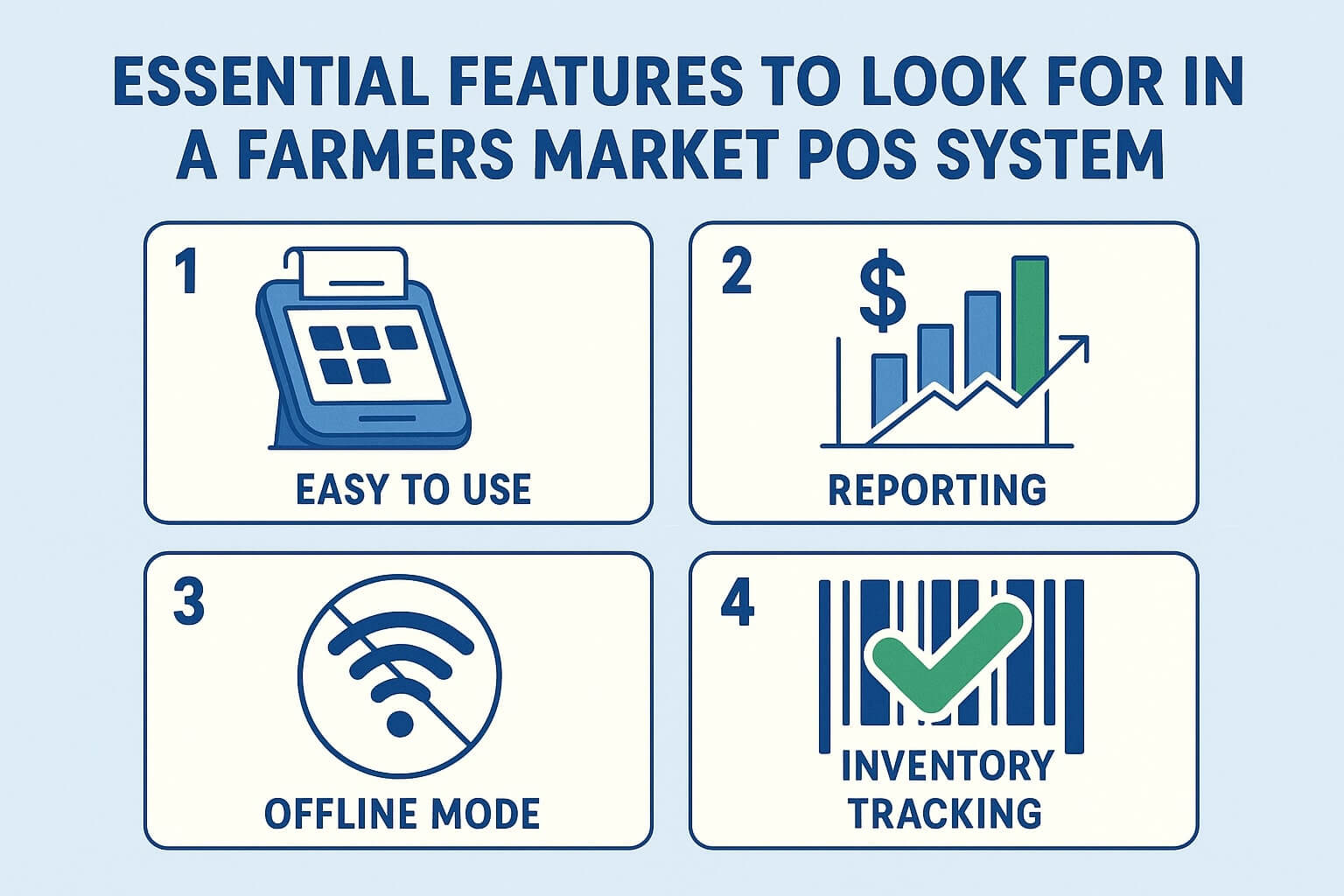
2. Offline Payment Processing With Automatic Sync
Many farmers markets operate in outdoor or semi-covered spaces where internet connectivity is inconsistent at best. Cellular signals can degrade in dense crowds, and reliance on stable Wi-Fi in open-air environments is rarely realistic. A POS system that cannot process transactions without an active internet connection will create disruptions during peak hours — exactly when reliability matters most.
The Operational Risk of Connectivity Gaps
When a payment system goes offline mid-market and has no offline mode, vendors are left choosing between turning customers away, accepting cash only, or manually recording transactions to be entered later. Each of these options introduces either lost revenue or data entry errors. Offline processing with automatic synchronization when the connection is restored is not a premium feature — it is a baseline requirement for outdoor retail environments.
3. SNAP/EBT and Incentive Program Integration
Farmers markets across the United States increasingly participate in federal nutrition assistance programs. The USDA’s Agricultural Marketing Service supports markets through programs that allow customers using SNAP benefits to purchase fresh produce, and many markets also run local matching incentive programs that double the spending power of benefit recipients. Managing these transactions separately from standard card and cash payments adds administrative complexity that a capable POS system should be able to absorb.
Compliance and Reporting Requirements
Markets accepting SNAP payments are subject to USDA authorization requirements and must maintain transaction records that demonstrate proper use of benefits. According to the USDA, farmers markets must follow specific procedures for SNAP transaction processing and record-keeping. A POS system that integrates EBT processing and automatically tags those transactions for reporting purposes reduces the administrative burden on market staff while keeping the market in good standing with program requirements.
4. Vendor Onboarding and Permit Tracking
Markets have licensing, permit, and insurance requirements that vendors must meet before they can sell. Tracking the status of these documents manually — across dozens of vendors, with varying renewal dates — is one of the more time-consuming administrative tasks a market manager handles. When a vendor’s health permit lapses or their certificate of insurance expires, the market assumes some level of liability if they are allowed to continue operating without valid documentation.
Automating Document Expiration Alerts
A POS platform with built-in vendor management should allow administrators to record permit and document expiration dates and receive alerts before they lapse. This removes the reliance on manual calendar tracking and ensures that no vendor is inadvertently allowed to operate out of compliance. The system becomes part of the market’s risk management process rather than simply a payment tool.
5. Inventory Management at the Vendor Level
For vendors selling perishable goods, inventory tracking is directly tied to both revenue and waste reduction. Selling out of a product before the market closes represents lost income, while carrying over unsold perishables represents a direct loss. A POS system that gives vendors real-time visibility into their own inventory levels helps them make better decisions about restocking, pricing, and end-of-day markdowns.
Practical Inventory Features for Agricultural Vendors
Inventory tools for agricultural vendors differ from traditional retail in meaningful ways. Products often vary in weight, the same item may be sold in multiple formats, and quantities fluctuate from week to week based on harvest conditions. Useful farm pos software will accommodate variable-weight items, allow category-level tracking alongside SKU-level tracking, and support rapid entry of new items at the start of each market day without requiring complex setup.
6. Centralized Market Reporting and Settlement Tools
At the end of each market day, the administrative work begins. Market managers need to verify total sales by vendor, calculate fee deductions, process vendor payouts, and compile records for the market’s own financial management. Doing this accurately and quickly depends on having clean, disaggregated data available from the moment the last transaction closes.
Fee Structures That Match Market Policies
Different markets charge vendors in different ways — some take a percentage of gross sales, others charge flat booth fees, and some use a combination. A POS platform that cannot accommodate these structures forces market managers to perform fee calculations outside the system, which introduces errors and slows settlement. The reporting module should allow administrators to configure vendor-specific or category-specific fee rules that apply automatically at settlement.
7. Customer Loyalty and Pre-Order Functionality
Repeat customers are the backbone of a stable farmers market, and building loyalty requires more than product quality. Markets that give customers a reason to return — through loyalty points, pre-order pickup arrangements, or member accounts — tend to see more consistent traffic over time. POS systems that support these features extend the market’s engagement with customers beyond the physical market day.
Pre-Orders and the Weekly Market Model
Pre-order capability, where customers place orders during the week for pickup at the next market, creates predictability for vendors and reduces the risk of customers leaving empty-handed. This is particularly valuable for vendors with limited production capacity or specialty items. Good farm pos software integrates pre-order management with the same inventory and sales system used on market day, so vendors are not tracking orders across separate platforms.
8. Hardware Flexibility Across Booth Formats
Farmers market vendors operate in a wide variety of physical configurations — folding tables, truck beds, permanent stalls, and mobile carts. No single hardware format works across all of them. A POS system that requires dedicated countertop terminals or specific hardware configurations will not work for vendors who set up and tear down weekly in variable conditions.
Mobile Compatibility as a Practical Requirement
Tablet and smartphone-based POS applications have become the standard for mobile vendor environments because they reduce hardware cost, simplify setup, and are easy to replace if damaged. The software layer matters as much as the hardware — the application should be stable on multiple device types, work with standard Bluetooth card readers, and not require a vendor to carry additional equipment that adds setup time or breakage risk.
9. Role-Based Access Controls
Not every person who uses a market’s POS system should have access to all of its functions. Vendors need access to their own sales data, inventory, and checkout tools. Market administrators need access to all vendor accounts, settlement tools, and reporting dashboards. Having clear separation between these access levels protects vendor data and reduces the risk of accidental or unauthorized changes to system settings.
Access Management in Practice
Role-based controls also make onboarding easier. New vendors can be given access to their own account without a full orientation on the entire system. Market staff can be granted permissions appropriate to their responsibilities without exposing administrative or financial functions. This structure is especially useful for markets that operate across multiple sites or days with different staff at each location.
10. Scalable Pricing That Reflects Market Size
Farmers markets range in size from small weekly neighborhood gatherings with ten vendors to large multi-day events with hundreds of participants. A POS system priced for large enterprise deployments may be financially out of reach for smaller markets, while a low-cost tool designed for single vendors may lack the structure needed for market-wide management. Evaluating farm pos software on pricing model — whether it is flat-rate, per-vendor, or per-transaction — is as important as evaluating its feature set.
Planning for Growth Without Replacing Infrastructure
Markets that start small often grow. A platform that functions well at launch but cannot scale to additional vendors, additional locations, or increased transaction volume creates the need for a disruptive system migration later. The better approach is to select a platform whose pricing and architecture can accommodate the market’s likely trajectory, even if some features are not immediately needed.
Closing Considerations for Market Managers Evaluating POS Systems
Selecting a point-of-sale system for a multi-vendor farmers market is a longer-term infrastructure decision, not a routine software purchase. The system touches every aspect of daily operations — vendor payments, customer experience, compliance documentation, and financial reconciliation. Getting it right at the outset reduces operational friction for vendors and staff, and creates a foundation that supports the market’s growth rather than limiting it.
The features outlined in this article are not aspirational extras. They reflect the practical requirements that emerge when running a market with real vendors, real customers, and real administrative accountability. Any platform under serious consideration should be able to demonstrate, not just claim, that it handles these requirements in the context of an agricultural market environment — before any contract is signed.
Investing time in a thorough evaluation — asking vendors about their experience, testing the system under realistic conditions, and speaking with other market managers who have deployed the software — will deliver more useful information than any product demonstration alone. The goal is a system that disappears into the background of daily operations because it works consistently, not one that demands ongoing attention to function.
