


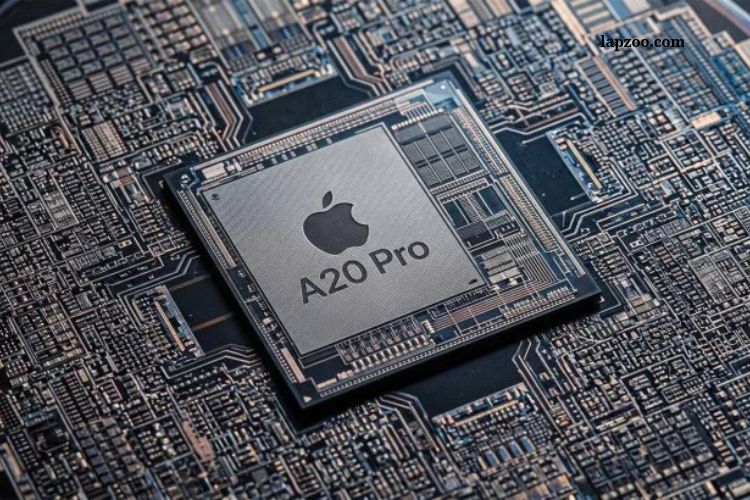
Apple is preparing to unveil its first 2nm iPhone chipset, the A20 Pro, at the upcoming “Surprise and Shine” event on September 9. The new chip is expected to power the iPhone 18 Pro, iPhone 18 Pro Max, and Apple’s first foldable iPhone.
Early leaks have already revealed important details about the A20 Pro. Apple reportedly plans to introduce Wafer-Level Multi-Chip Module (WMCM) packaging, replacing the InFO_PoP technology used in previous generations. A newly leaked front-side die shot now provides another exciting look at the upcoming silicon, hinting at a major GPU upgrade and improved memory architecture.
The leaked design suggests that Apple could increase the GPU core count while making several architectural changes aimed at improving graphics and memory performance.
Read More: SpaceX IPO Plans Put the Commercial Space Industry Under Fresh Investor Attention
A20 Pro Could Feature a 7-Core GPU
One of the most notable details from the leaked A20 Pro die shot is the possibility of a 7-core GPU. If accurate, the increase could deliver a substantial boost to graphics performance compared with the previous-generation A19 Pro.
A higher GPU core count can provide additional graphics processing capacity, potentially benefiting demanding games, video editing, 3D applications, and other GPU-intensive workloads. Apple has consistently focused on performance-per-watt, so the A20 Pro could combine increased graphics power with the efficiency advantages of its advanced 2nm manufacturing process.
The new GPU configuration could become particularly important for the iPhone 18 Pro lineup and Apple’s first foldable device. Larger and higher-resolution displays may require additional graphics capability, making the rumored GPU improvement especially interesting.
New WMCM Packaging Could Transform Memory Performance
The A20 Pro’s packaging technology represents another significant change. Apple is reportedly moving from InFO_PoP packaging to WMCM, allowing the company to arrange the memory dies differently around the main SoC.
With the older approach, memory was stacked above the processor package. The new WMCM design could instead place the memory dies beside the SoC. This arrangement may give Apple more flexibility when designing the memory interface and could increase the memory bus width to 96 bits.
The chipset is expected to continue using LPDDR5X memory, rather than moving to the newer and potentially more expensive LPDDR6 standard.
This strategy could allow Apple to increase memory bandwidth without requiring a completely new memory technology. Higher bandwidth can help the processor and GPU access data more quickly, potentially improving performance in demanding applications.
CPU Configuration May Remain Unchanged
Despite the rumored GPU improvements, Apple may not increase the number of CPU cores in the A20 Pro.
The leaked information suggests that the processor could retain a six-core CPU configuration, consisting of two performance cores and four efficiency cores. This would mirror the basic CPU arrangement found in the A19 Pro.
Keeping the same CPU core count does not necessarily mean the A20 Pro will deliver the same CPU performance. Apple can improve performance through architectural refinements, higher efficiency, improved cache design, and the benefits of the 2nm manufacturing process.
This approach could also help Apple maintain a balance between performance and battery efficiency. Instead of simply adding more cores, Apple may focus on making its existing architecture faster and more efficient.
Larger L2 Cache Could Improve Efficiency-Core Performance
The A20 Pro could also receive an important cache upgrade.
According to the leaked information, each of the two performance cores may continue to feature 16MB of L2 cache, matching the A19 Pro. However, the efficiency cores could receive a larger cache.
The efficiency-core L2 cache is reportedly expected to increase from 6MB to 8MB. A larger cache can allow processors to keep more frequently accessed data closer to the CPU cores, reducing the need to access slower memory.
This change could improve responsiveness and efficiency in everyday workloads. While cache size alone does not determine processor performance, it can contribute to better overall CPU behavior when combined with architectural improvements.
Bigger Neural Engine Could Strengthen AI Capabilities
Previous leaks have also pointed toward a larger Neural Engine in the A20 Pro.
Apple has increasingly emphasized on-device artificial intelligence and machine-learning features across its hardware ecosystem. A more capable Neural Engine could therefore become an important part of the A20 Pro’s overall upgrade package.
AI workloads can include image processing, voice recognition, computational photography, generative features, and other tasks that require fast machine-learning calculations. A larger Neural Engine could help the upcoming iPhone models handle these workloads more efficiently.
However, the leaked die shot does not clearly identify every Neural Engine or ISP block. As a result, several details about Apple’s AI and image-processing improvements remain unknown.
96-Bit Memory Bus Could Deliver More Bandwidth
The rumored 96-bit memory bus is another potentially important upgrade.
A wider memory bus allows the processor to transfer more data during each memory operation. Combined with LPDDR5X technology, the wider interface could significantly increase available memory bandwidth.
This could be especially beneficial for the rumored 7-core GPU. Graphics processors often depend heavily on memory bandwidth when handling high-resolution textures, complex scenes, and demanding visual workloads.
Apple could therefore be creating a more balanced architecture where the GPU receives additional processing power while the memory system is upgraded to provide the necessary data throughput.
What the 2nm Process Means for the A20 Pro
The move to a 2nm manufacturing process is expected to be one of the A20 Pro’s biggest technological advances.
Smaller process technology can potentially enable greater transistor density while improving power efficiency and performance. However, the actual benefits depend on Apple’s chip design, manufacturing implementation, clock speeds, and workload optimization.
The combination of a 2nm process, new packaging, expanded GPU configuration, and improved memory architecture could make the A20 Pro a significant step forward.
Real-world performance will ultimately depend on how Apple implements these technologies in the final production chip.
Apple’s First Foldable iPhone Could Benefit
The A20 Pro is also expected to appear in Apple’s first foldable flagship, making its architecture even more interesting.
A foldable iPhone could demand substantial processing and graphics resources because of its larger display and potentially more advanced multitasking capabilities. The combination of a stronger GPU and higher memory bandwidth could help the device manage these workloads.
The new packaging technology could also provide Apple with additional flexibility when designing compact high-performance devices. However, the exact specifications of the rumored foldable iPhone remain unconfirmed until Apple officially introduces it.
Several Details Are Still Unknown
Although the leaked die shot provides valuable clues, it does not reveal everything about the A20 Pro.
Apple has yet to officially confirm the GPU core count, memory configuration, cache changes, Neural Engine specifications, or detailed CPU architecture. The actual performance and power efficiency of the chip will also remain uncertain until independent testing becomes available.
Benchmarks will be particularly important because specifications alone cannot fully explain how a processor performs under real-world workloads.
Gaming, video editing, AI processing, multitasking, and battery tests should provide a clearer picture of the A20 Pro’s capabilities once compatible devices reach reviewers and consumers.
Frequently Asked Questions:
What is the Apple A20 Pro?
The A20 Pro is Apple’s next-generation flagship mobile chipset expected to power upcoming high-end iPhone models. It is reportedly built using a 2nm process.
How many GPU cores could the A20 Pro have?
The A20 Pro is rumored to feature a 7-core GPU, which could provide stronger graphics performance than the previous generation.
What graphics improvements could the A20 Pro offer?
A higher GPU core count could improve gaming, video editing, 3D applications, and other demanding graphics workloads.
Will the A20 Pro use 2nm technology?
Yes, the A20 Pro is expected to be Apple’s first iPhone chipset manufactured using a 2nm process, potentially improving performance and power efficiency.
What is new about the A20 Pro packaging?
Apple is reportedly moving to Wafer-Level Multi-Chip Module (WMCM) packaging, replacing the older InFO_PoP approach.
Could the A20 Pro have a wider memory bus?
Reports suggest the A20 Pro could use a 96-bit memory bus while retaining LPDDR5X memory, potentially increasing memory bandwidth.
Will the A20 Pro have more CPU cores?
Current leaks suggest that Apple may retain a six-core CPU configuration with two performance cores and four efficiency cores.
Conclusion
Apple’s A20 Pro could represent a major leap in iPhone performance, with its rumored 7-core GPU, 2nm process, wider 96-bit memory bus, improved cache, and larger Neural Engine. The new WMCM packaging may further enhance memory bandwidth and overall efficiency. While these details are based on leaks and remain unconfirmed, the A20 Pro is shaping up to be an exciting next-generation chipset. Official specifications and real-world benchmarks will reveal how significant the improvements truly are.