


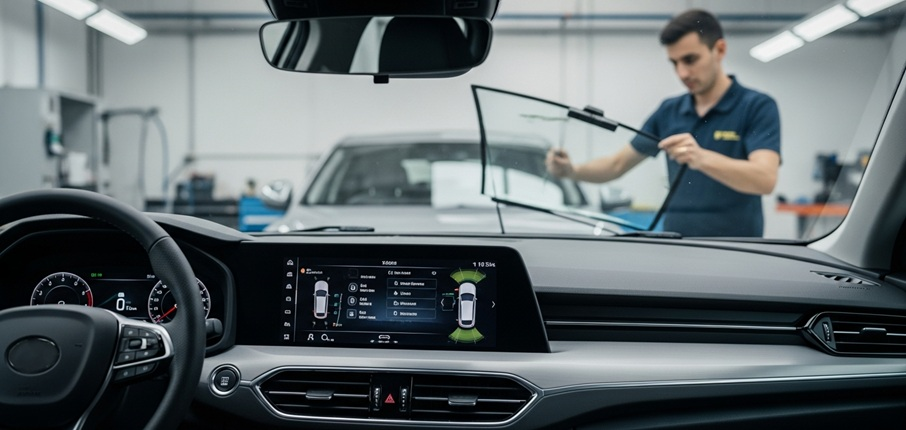
Most drivers have never heard of ADAS until something goes wrong. A windscreen gets replaced after a stone chip spreads, a car park bump leaves a scuff on the bumper, or a dashboard light appears that was not there yesterday. Then the repairer says the car “needs calibrating” and the conversation gets confusing very quickly. Is it really necessary? Is it a way to add cost to a job that already felt expensive? And what happens if you simply skip it?
This guide answers those questions in plain language. It covers what the systems do, why they are sensitive to repairs that seem unrelated, how the process works, and what to look for so that the work is done properly the first time.
The Short Answer
ADAS stands for advanced driver assistance systems. These are the cameras, radar units and sensors that power features such as automatic emergency braking, lane keeping, adaptive cruise control and blind spot warnings. Each sensor is aimed at a precise angle, and the car’s computer relies on that angle being exactly right. When a windscreen is replaced, a bumper is repaired, or the suspension or wheel alignment is changed, that angle can shift by a fraction of a degree. At highway speeds, a tiny shift at the sensor becomes a large error on the road ahead. Calibration resets the system so it sees the world accurately again.
If your car has these features and has had any of those repairs, calibration is not an optional extra. It is the final step of the repair.
What ADAS Actually Does in Your Car
It helps to understand what is being calibrated before talking about why. Most modern vehicles, particularly European models built over the last several years, carry a combination of the following:
- Automatic emergency braking, which detects a vehicle, cyclist or pedestrian ahead and applies the brakes if you do not react in time
- Lane departure warning and lane keeping assistance, which watch the road markings and nudge the steering or sound an alert if you drift
- Adaptive cruise control, which holds a set distance from the vehicle in front using a forward radar
- Blind spot monitoring, which uses radar in the rear corners to detect vehicles you cannot see in the mirrors
- Traffic sign recognition, which reads speed signs and displays them on the dash
- Pedestrian detection and avoidance, which combines camera and radar data to spot people near the road
None of these features are guesses. They are measurements. The forward camera mounted behind the windscreen, for instance, is looking for lane lines and vehicles at specific distances. If the camera sits even slightly off its intended position, a car that appears to be centred in its lane might be judged by the computer to be drifting, or a vehicle two cars ahead might be judged to be much closer than it really is.
Why a Windscreen Replacement Affects Your Safety Systems
Of all the repairs that call for recalibration, the windscreen is the one most drivers are surprised by. After all, glass is glass. But on a car with driver assistance, the windscreen is a precision component.
The forward camera is bonded to the glass or mounted on a bracket attached to it. When the old windscreen comes out and a new one goes in, the camera is removed and refitted, and the new glass will never sit in exactly the same position as the old. Tolerances in the glass itself, the thickness of the adhesive and the angle of the mounting bracket all combine to move the camera’s view slightly. The camera then needs to be taught where it is now pointing.
There is also a second issue. Some windscreens include a specific tint, a coating or an embedded heating element in the camera’s field of view. A glass that is not the correct specification for the vehicle can distort what the camera sees, even if it looks perfect to the eye. This is one reason it matters to use quality glass and to have the work checked afterwards.
A windscreen replacement is also where drivers most often skip the follow-up step by accident. The glass fitter finishes the job, the car looks fine, no warning light appears and the driver heads off. The system may appear to work, but it is operating on outdated information. The danger is that you will not find out until the moment the feature is needed.
Why a Minor Collision Can Matter More Than It Looks
A low speed bump in a car park, a tap at traffic lights or a shunt that leaves little visible damage can still disturb the sensors. Modern bumpers are designed to absorb impact, which means they often flex, and the radar units mounted behind them can be knocked out of alignment without any visible crack or dent.
The key sensors affected by a collision include:
- Front radar, usually behind the front bumper cover or the grille badge, used for adaptive cruise control and emergency braking
- Rear corner radar, behind the rear bumper, used for blind spot and rear cross traffic alerts
- Parking sensors and surround view cameras, which can be shifted by a bump to a mirror, door or bumper
- Forward camera, which can be disturbed by a hard jolt even if the glass is not damaged
An important point is that a repaired bumper, even if it looks flawless, may not hold the sensor bracket in exactly the factory position. Panel repairs, paint work and the refitting of a bumper cover are all moments where alignment can drift. A responsible repair includes checking the sensors afterwards, not just the panel.
Other Repairs That Can Trigger Recalibration
The windscreen and the bumper are the two most common causes, but they are not the only ones. Calibration is also commonly required after:
- Wheel alignment changes, because the car’s thrust angle (the direction it actually travels) is used as a reference by the cameras and radar
- Suspension work, including new springs, shock absorbers or a change in ride height, which alters the angle at which sensors point
- Mirror and door replacement, where blind spot or camera units are mounted
- Airbag and structural repairs, which can change the position of sensors fitted in pillars or the dashboard
- Replacement of a control module or sensor, which will need to be taught its position from scratch
- Fitting a different tyre size, which can affect speed and distance calculations
This list surprises many drivers. A simple wheel alignment after hitting a pothole can mean the system needs to be checked, particularly on European vehicles where the manufacturer specifies calibration as part of the procedure.
How Calibration Is Actually Done
There are two main methods, and many vehicles require one or both.
Static Calibration
Static calibration is carried out with the car stationary in a controlled workshop. The vehicle is positioned precisely on a level floor, and printed targets or reflective boards are placed at exact distances and heights in front of the car. A diagnostic tool connected to the car’s computer then instructs the sensors to find these targets, measure where they appear and adjust their internal reference.
This method requires space, level ground, the right equipment and careful measurement. It is the preferred or required method for many cameras and radar units, because it removes variables such as traffic, weather and road quality.
Dynamic Calibration
Dynamic calibration is carried out while the car is driven on the road, typically at a set speed on a route with clear lane markings. The system learns by observing real road features. It is faster in some cases, but it depends on good conditions, and it is not suitable for every vehicle or every sensor.
Many manufacturers require a static procedure first, followed by a dynamic drive, or specify one over the other for particular models. The correct approach is dictated by the manufacturer’s repair procedure, not by what is convenient. A workshop that follows the procedure for your specific make and model is one that understands what is at stake.
The Role of Modern Optical Positioning Equipment
Some workshops now use advanced optical positioning systems that measure the position of the vehicle in three dimensions using multiple high definition cameras, rather than relying on tape measures and plumb bobs. This improves accuracy, reduces setup time and makes it easier to document the process. The result is a more repeatable calibration with a clear record of the measurements taken.
Signs That Your Driver Assistance Systems Need Attention
Sometimes the car tells you that something is wrong, and sometimes it does not. Watch for:
- A warning light or message about a driver assistance fault, camera or radar
- Lane keeping that pulls or alerts when you are driving straight in the middle of the lane
- Adaptive cruise control braking unexpectedly or leaving a different gap to the car ahead than usual
- Emergency braking alerts when there is no obstacle, or a failure to alert when there should be
- Blind spot warnings that trigger inconsistently or not at all
- Traffic sign recognition showing incorrect limits
- A dashboard message after a repair saying a system is unavailable
The most worrying scenario is the one with no symptom at all. A sensor that is slightly misaligned can work well enough on a normal day and fail when it matters most. This is why the general rule is to calibrate after the relevant repair, not to wait for evidence of a problem.
What Happens If You Skip Calibration
Skipping calibration is a gamble, and the stakes are your safety and that of the people around you. An uncalibrated forward camera can misjudge the distance to the vehicle ahead, which affects both warnings and automatic braking. A misaligned radar can be slow to detect a stopped vehicle or react to something that is not there.
There are also practical consequences. If a crash occurs and the car’s systems are found to have been uncalibrated after a repair, questions can arise around the quality of the repair and potentially around insurance. Resale value and trade in inspections can also be affected if a vehicle has a record of unresolved driver assistance faults.
Finally, there is the nuisance factor. A system that triggers false alarms or intervenes unexpectedly can be disruptive and distracting, and many drivers end up turning features off altogether, which defeats the purpose of having them.
ADAS Calibration on European Vehicles
European makes tend to be among the most sophisticated when it comes to driver assistance, and they are also among the most particular about how calibration is carried out. Audi, BMW, Mercedes-Benz, Volkswagen, Volvo, Mini, Skoda, Renault and Land Rover all publish detailed procedures, and these vary by model and year. Some require specific target boards, some need a particular diagnostic software version, and some need the car to be in a defined state, such as a set tyre pressure, fuel level and ride height, before the process begins.
For European car owners, this is a strong reason to choose a workshop with the right diagnostic tools and model specific knowledge. Generic equipment can sometimes complete a calibration on a simpler vehicle, but a mismatch on a more complex European model can mean an incomplete or inaccurate result.
How to Choose Where to Have It Done
Not every workshop that offers calibration offers the same standard. When you are comparing options, consider asking:
- Do you follow the manufacturer’s procedure for my exact make and model? The answer should be yes, and they should be able to explain which method applies.
- Is the calibration static, dynamic or both, and why? A clear answer shows understanding.
- What equipment do you use? Modern positioning systems and up to date diagnostic software matter.
- Will I receive a report or printout showing the calibration was completed successfully? This is useful for your records and for insurers.
- Can you handle work for insurers and repairers as well as private owners? This indicates experience with the paperwork around post repair verification.
- What happens if the calibration fails? A good workshop will diagnose the cause rather than simply retry.
Price matters, but it should not be the only factor. A calibration that is cheap but incomplete is not a saving. Whichever workshop you choose, pick one that can show you how the work is done and what you will receive at the end.
Questions to Ask Before a Windscreen or Bumper Repair
Planning ahead saves time and avoids surprises. Before booking a windscreen replacement or a collision repair on a car with driver assistance features, ask the repairer:
- Does my car have systems that will need calibration after this repair?
- Is calibration included in the quote, or is it a separate service?
- Will it be done on site, or will the car need to go elsewhere afterwards?
- How long will the whole process take, and will I be without the car?
- Will I receive confirmation that calibration was carried out and passed?
If the repairer is vague on any of these, it is a good idea to clarify before the work begins. Having the answers in advance makes it easier to arrange the right specialist and to avoid driving the car in an uncalibrated state.
A Practical Checklist for Car Owners
- Check your owner’s manual or ask a specialist whether your car has driver assistance features
- Tell any windscreen, panel or suspension repairer that your car has these systems
- Ask whether calibration is required for your specific repair and who will carry it out
- Keep the invoice and any calibration report for your records
- Have the system checked after a wheel alignment, suspension change or minor bump if the manufacturer calls for it
- Do not ignore dashboard warnings about driver assistance
- Test the features sensibly after the work and report anything unusual straight away
Final Word
Driver assistance technology is only as good as the accuracy behind it. A new windscreen, a repaired bumper or an adjusted suspension are everyday events in a car’s life, and calibration is what makes sure the safety features still do their job afterwards. It is a small step compared with the repair itself, and it is the step that matters most when you need the car to react.
If you live in Perth and are looking for ADAS calibration in Perth for a European or other late model vehicle, our team can walk you through what your car needs and what to expect. Get in touch with us at our Armadale workshop to book a check or to ask any questions before your next repair.
Frequently Asked Questions
1. Does every car need calibration after a windscreen replacement?
No, but any car with a forward facing camera mounted at the windscreen generally does. Many vehicles built in the last several years have one for lane keeping, emergency braking or traffic sign recognition. The safest approach is to check with a specialist or the manufacturer’s procedure for your specific make and model before the glass is replaced.
2. How long does recalibration take?
It depends on the vehicle and the systems involved. Some jobs take under an hour, while a vehicle needing both static and dynamic procedures across several sensors can take longer. Setup, diagnostics and test driving all add time, so it is best to ask for an estimate when you book.
3. Can I just drive for a while and let the car recalibrate itself?
Some systems do self adjust during normal driving within a limited range, but this is not a substitute for a proper procedure when a sensor has been moved by a repair. Many manufacturers specify a defined process, and relying on self adjustment alone can leave the system working with inaccurate settings.
4. Will my insurer cover the cost of calibration after a collision?
In many cases, calibration is treated as part of the repair when it is required by the manufacturer’s procedure, but policies differ. It is worth confirming with your insurer and your repairer before the work begins, and keeping the invoice and calibration report on file.
5. How do I know the work was done properly?
Ask for a printout or report from the diagnostic equipment showing the procedure was completed and passed. A reputable workshop will provide this as a matter of course. After the work, the dashboard should be free of driver assistance warnings, and the features should behave normally on a sensible test drive.
