


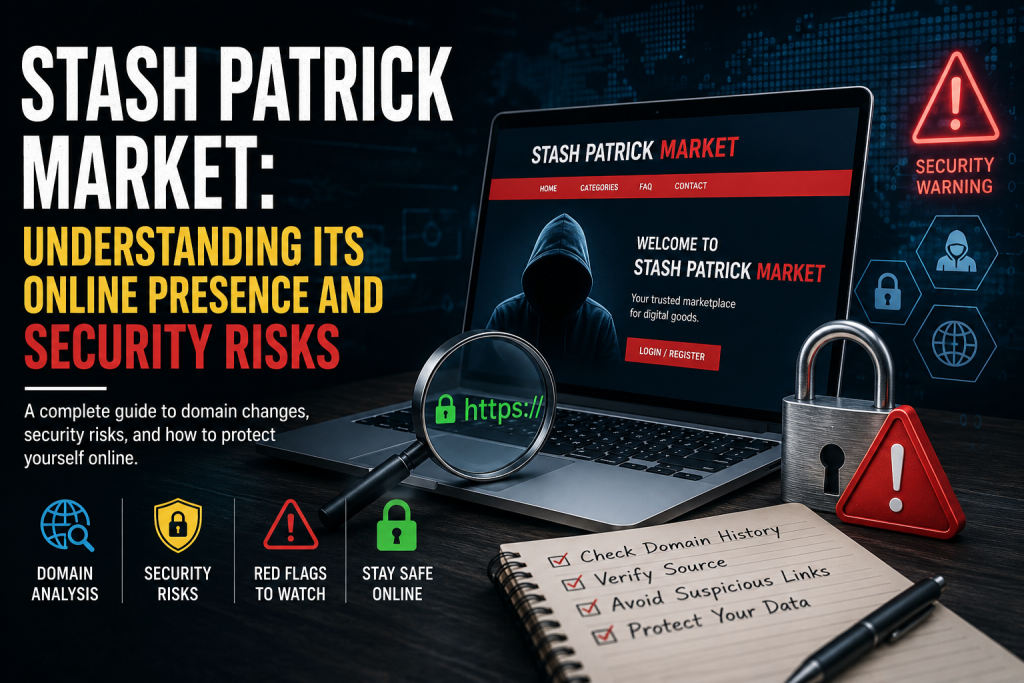
Online marketplaces can appear, disappear, rebrand, or move between domains with surprising speed. For ordinary internet users, these changes can make it difficult to determine whether a website is legitimate, trustworthy, or even connected to the platform it claims to represent. Searches involving Stash Patrick Market, Stashpatrick Shop Security, and similar terms highlight why careful verification matters before visiting unfamiliar websites or sharing personal information.
A website name alone should never be treated as proof of legitimacy. Similar spelling, copied branding, newly registered domains, and misleading search results can all create confusion. Users researching names such as Stash patrick Market, Patrick Stash Market, stashpatrick.gl, or stashpatrick.name should therefore focus less on promotional claims and more on measurable security indicators.
This article examines the online presence associated with these search terms from a digital safety perspective. It does not endorse, verify, or recommend any particular marketplace. Instead, the goal is to explain practical warning signs and safer ways to evaluate unfamiliar domains.
Why the Stash Patrick Market Name Requires Careful Research
When people search for Stash Patrick Market, they may encounter multiple variations of the same or similar name. This can create uncertainty about which website, if any, represents an authentic service.
Name variations are common online. Sometimes they result from legitimate branding changes, but they can also appear because unrelated operators use similar names to attract existing search traffic. A domain may imitate another site’s wording, colors, layout, or logo without having any genuine connection to it.
This is why searches for Patrick Stash Market or Stash patrick Market should be approached carefully. Instead of assuming that similar names belong to the same operator, users should evaluate each domain independently.
Important questions include:
- When was the domain registered?
- Does the website clearly identify who operates it?
- Is meaningful contact information available?
- Does the site explain its privacy and data-handling practices?
- Are independent security warnings associated with the domain?
- Does the website request unusually sensitive information?
A convincing appearance is not enough. Modern website templates can make an unknown domain look professional within minutes.
Understanding Stashpatrick Shop Security
Stashpatrick Shop Security is a phrase users may search when trying to determine whether a particular site is safe to visit. Security assessment, however, involves much more than checking whether a browser displays a padlock.
HTTPS encryption is important because it protects information traveling between a browser and a website. However, HTTPS does not prove that the person or organization operating the website is trustworthy. Fraudulent and deceptive sites can also obtain valid security certificates.
A stronger assessment considers several factors together. Domain history, reputation, transparency, security configuration, external reports, and the type of information requested by the site all matter.
Users should be particularly cautious when a website asks for financial credentials, identity documents, account passwords, cryptocurrency transfers, or other sensitive data without providing a clear explanation of who operates the service.
Security is therefore a combination of technical protection and organizational trustworthiness.
What a Stashpatrick CC Review Should Examine
Someone searching for a Stashpatrick CC Review may be looking for information about reputation, reliability, or user experiences. Reviews can provide useful clues, but they should not be accepted automatically as evidence.
Online reviews can be manipulated. Positive comments may be fabricated, while negative comments can sometimes be exaggerated or unrelated to the actual service. The most useful approach is to compare information from several independent sources.
A responsible Stashpatrick CC Review should examine factors such as domain age, ownership transparency, security warnings, privacy practices, payment methods, and consistency across the site’s public information.
The language used in reviews also deserves attention. Large numbers of nearly identical comments, repetitive wording, unrealistic praise, or posts published within a very short period can indicate artificial reputation building.
Readers should distinguish between verifiable observations and anonymous claims. A review saying that a domain was registered recently can potentially be checked. A comment simply saying that a site is “100 percent trusted” provides very little meaningful evidence.
Why a Patrickstash New Domain Can Be a Warning Sign
Domain changes are not automatically suspicious. Businesses sometimes move because of rebranding, technical improvements, regional expansion, or changes in domain strategy. Still, a Patrickstash New Domain should be verified before users assume that it is connected to an older website.
Frequent domain switching can increase risk because users may have difficulty distinguishing an official migration from an imitation.
Suppose a user sees a message claiming that an existing platform has moved to another address. Before following that claim, the user should look for confirmation through established and independently verifiable channels.
A newly created domain deserves additional scrutiny when it:
- Claims to replace an older site without reliable confirmation
- Uses branding copied from another domain
- Provides little information about its operators
- Immediately requests payments or sensitive credentials
- Creates urgency around registration or deposits
- Has little independent history or reputation
The newer the domain, the less historical evidence may exist to evaluate its behavior.
Evaluating Domains Such as stashpatrick.gl
A domain such as stashpatrick.gl should be assessed independently rather than trusted because its wording resembles a familiar name.
Start with the domain itself. Check its registration history where legally and technically available. A recently registered domain is not necessarily dangerous, but its age provides context. If a website claims years of history while its domain appeared only recently, that inconsistency deserves investigation.
Next, inspect the site’s technical behavior. Unexpected redirects, repeated pop-ups, forced downloads, browser security warnings, and requests to disable protective features should be treated seriously.
Users should also pay attention to the information the site requests. An unfamiliar platform asking for unnecessary personal details creates a larger privacy risk than one that allows visitors to browse public information without registration.
Never install unknown applications, browser extensions, certificates, or executable files simply because a website says they are required for access.
What to Consider When Researching stashpatrick.name
The same principles apply to stashpatrick.name. A recognizable keyword inside a domain does not establish ownership, authenticity, or affiliation.
One useful step is comparing the website’s claims with independently available information. Look for consistency in dates, branding, contact information, policies, and public statements.
Privacy documentation is particularly important. A legitimate privacy notice should provide meaningful information about what data is collected, why it is collected, how long it is retained, and whether it is shared with third parties.
Generic or copied policy pages deserve caution. For example, if a privacy policy refers to a completely different company or domain, it may indicate that the website was assembled from reused templates.
Contact information should also be examined. An email form alone offers limited accountability. Transparent organizations generally provide clearer information about who operates their services.
Common Security Risks Around Unfamiliar Online Markets
Unknown online marketplaces can expose visitors to several types of digital risk. The exact risk depends on how a particular site operates, but users should understand the most common possibilities.
Phishing is one concern. A website may imitate another service in an attempt to collect usernames, passwords, payment information, or other credentials.
Malware is another risk. Suspicious sites may encourage visitors to download files, applications, browser extensions, or updates that contain harmful software.
Financial loss can occur when a platform requests irreversible payments without providing reliable buyer protection. Cryptocurrency transactions require particular care because completed transfers are often difficult or impossible to reverse.
Identity exposure is equally important. Copies of identification documents, phone numbers, email addresses, passwords, and financial details can be valuable to criminals even when no immediate financial theft occurs.
Similar Names Do Not Prove a Connection
One of the most important lessons when researching Patrick Stash Market and related terms is that branding similarity should never replace verification.
Cybercriminals often take advantage of small spelling differences. They may add a letter, remove a character, change the domain extension, or insert a hyphen. At a quick glance, the address can look genuine.
This technique is sometimes described as typosquatting. Its effectiveness depends on users recognizing the familiar part of a name while overlooking subtle differences.
Always read the complete domain before interacting with a website. Search advertisements and social media posts should receive the same level of scrutiny because a familiar-looking name can still lead somewhere unexpected.
Protecting Personal and Financial Information
Users investigating Stashpatrick Shop Security or a Patrickstash New Domain should prioritize the protection of their own devices and accounts.
Use unique passwords for important services and enable multi-factor authentication whenever possible. Reusing the same password across multiple websites can turn one compromised account into several compromised accounts.
Keep browsers, operating systems, and security software updated. Modern browsers can detect some known malicious websites, although no protection system catches every threat.
Avoid entering sensitive information while using public or unsecured networks. More importantly, question why an unfamiliar website needs particular information in the first place.
If a site requests excessive data without a legitimate reason, leaving the website is usually safer than proceeding.
Red Flags That Deserve Immediate Attention
Certain behaviors should make users reconsider interacting with an unfamiliar marketplace.
Watch for extreme urgency, guaranteed profits, unrealistic discounts, anonymous ownership, inconsistent contact details, broken policy pages, suspicious downloads, and requests for irreversible payments.
Poor grammar alone does not prove that a website is unsafe. Likewise, attractive design does not prove that it is legitimate. Security judgments should rely on multiple indicators rather than one superficial characteristic.
Browser warnings deserve particular attention. Users should not bypass certificate or malware warnings simply because a website claims the warning is harmless.
A Safer Approach to Researching Stash Patrick Market
The safest approach to Stash Patrick Market and related domain names is evidence-based verification. Searches involving Stashpatrick CC Review, Patrickstash New Domain, Stash patrick Market, Patrick Stash Market, stashpatrick.gl, and stashpatrick.name may produce conflicting claims, so users should avoid making decisions based on a single page or anonymous comment.
Check domain history, compare independent sources, inspect privacy practices, review security warnings, and avoid providing unnecessary information. If important details cannot be independently confirmed, uncertainty itself should be treated as a reason for caution.
Online safety depends on habits more than appearances. Professional design, familiar branding, HTTPS encryption, and positive comments can all be useful signals, but none proves that an unfamiliar marketplace is trustworthy. Taking a few extra minutes to verify a domain can help protect personal data, financial information, devices, and online accounts.
Make Verification Your First Line of Defense
The internet makes it easy for websites to change names, move between domains, and reproduce familiar branding. That flexibility is useful for legitimate businesses, but it can also create opportunities for impersonation and deception.
Anyone researching Stash Patrick Market should therefore separate recognition from trust. A familiar name is only a starting point. What matters is whether the website’s identity, history, security practices, and public claims can be independently verified.
Treat every unfamiliar domain as something that needs evaluation before interaction. Check carefully, avoid rushed decisions, protect sensitive information, and never assume that two similarly named websites belong to the same operator. These simple habits provide a stronger defense against phishing, impersonation, privacy loss, and other online security risks.
