


Getting the Certificate of Incorporation feels like the finish line, but legally, it’s the starting gun. A large number of founders in India believe that once the Ministry of Corporate Affairs (MCA) issues the Certificate of Incorporation (COI) following their company registration, their company is ready to trade, invoice clients, and take on investors. That assumption is where most early-stage compliance trouble begins.
A Private Limited Company cannot legally commence business, open certain accounts, or exercise borrowing powers until specific post-incorporation formalities are completed. Skip them, and you risk a ₹50,000 penalty on the company, ₹1,000 per day on directors, DIN deactivation, or even strike-off proceedings by the Registrar of Companies (ROC). This isn’t a rare occurrence either, MCA adjudication orders through 2026 continue to penalise companies that delayed filings like INC-20A by even a few months.
Why Post-Incorporation Compliance Matters?
Post-incorporation compliance refers to the mandatory legal, tax, and regulatory steps a company must complete after receiving its Certificate of Incorporation, before it can legally commence business operations, raise funds, or enter contracts.
Under the Companies Act, 2013, private limited company registration alone does not authorise a company to start operations. Section 10A specifically bars a company with share capital from commencing business or exercising borrowing powers until it files a declaration confirming that subscribers have paid up their share capital. Ignoring this distinction is one of the most common, and costly, mistakes new founders make.
Did You Know? In a January 2026 adjudication order, the MCA imposed a ₹50,000 penalty on a company and ₹1,00,000 on a single director for a 304-day delay in filing Form INC-20A, a filing that costs just ₹200 in government fees if done on time.
Post-Incorporation Compliance Checklist: Complete Overview
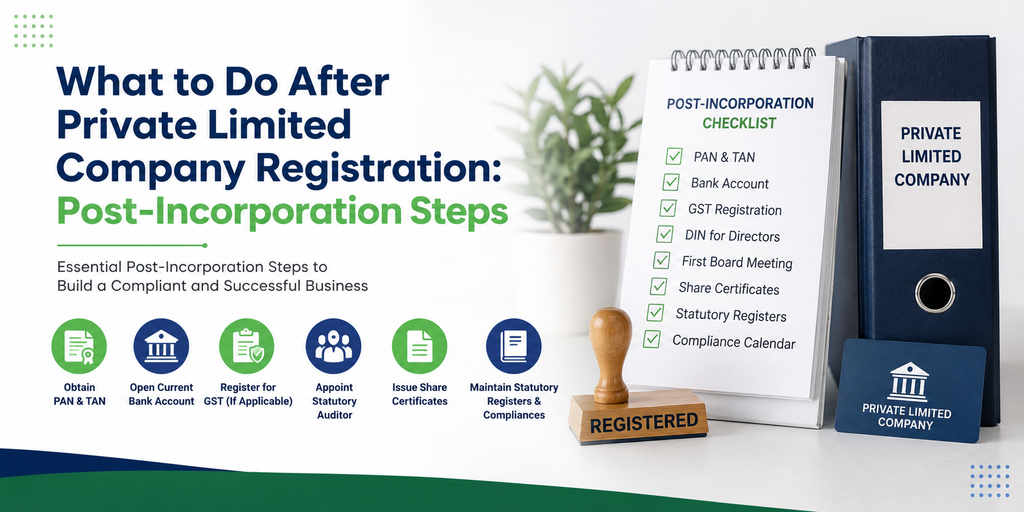
The core steps are: open a bank account, deposit subscription money, hold the first Board Meeting, appoint the first auditor, file INC-20A, apply for GST/MSME/Shops Act registrations if applicable, issue share certificates, and maintain statutory registers.
| Step | Action Required | Deadline | Governing Provision |
| 1 | Open current bank account | Before deposit of subscription money | Companies Act, 2013 |
| 2 | Deposit subscription money by all subscribers | Before filing INC-20A | Section 10A |
| 3 | Appoint first statutory auditor | Within 30 days of incorporation | Section 139(6) |
| 4 | File Form ADT-1 (auditor appointment) | Within 15 days of appointment | Companies (Audit and Auditors) Rules, as amended 2025–26 |
| 5 | File Form INC-20A (commencement of business) | Within 180 days of incorporation | Section 10A |
| 6 | Apply for PAN & TAN (usually auto-generated with incorporation) | Immediate | Income Tax Act, 1961 |
| 7 | Apply for GST registration, if applicable | Within 30 days of becoming liable | CGST Act, 2017 |
| 8 | Register under MSME (Udyam), if eligible | As soon as eligible | MSME Development Act, 2006 |
| 9 | Register for PF/ESI, if applicable | On crossing employee threshold | EPF & ESI Acts |
| 10 | Obtain Shops & Establishment registration | State-specific, typically 30 days | State-specific Acts |
| 11 | Issue share certificates to subscribers | Within 60 days of incorporation | Section 56(4) |
| 12 | Maintain statutory registers & minute books | Ongoing | Section 88, 118 |
| 13 | Hold first Board Meeting | Within 30 days of incorporation | Section 173(1) |
| 14 | Hold first AGM | Within 9 months of first FY end | Section 96 |
| 15 | File DIR-3 KYC for all directors | By 30 June triennially | Rule 12A |
| 16 | File AOC-4 and MGT-7/7A | 30/60 days from AGM | Sections 137, 92 |
Step 1: Open a Company Bank Account
A current account in the company’s name is required to deposit the subscription money that shareholders committed to incorporation, without this, INC-20A cannot be filed and the company cannot legally begin operations.
Documents typically required by banks include:
- Certificate of Incorporation
- Memorandum of Association (MOA) and Articles of Association (AOA)
- Board Resolution authorising account opening
- PAN of the company
- Identity and address proof of directors
- Registered office address proof
Step 2: Deposit Subscription Money and File Form INC-20A
Form INC-20A is a mandatory declaration under Section 10A of the Companies Act, 2013, confirming that every subscriber to the MOA has paid the value of shares they agreed to take, filed by a director within 180 days of incorporation.
This applies to every company incorporated on or after 2 November 2018 and having share capital. Until INC-20A is filed:
- The company cannot commence business
- The company cannot exercise borrowing powers
- The company cannot open certain operational accounts or sign material contracts
INC-20A: Key Facts
| Particular | Detail |
| Applicable to | Companies with share capital, incorporated on/after 2 Nov 2018 |
| Time limit | 180 days from incorporation |
| Government fee | ₹200 (flat, on MCA V3 portal) |
| Key attachment | Bank statement showing deposit of full subscription money |
| Certifying professional | CA / CS / Cost Accountant |
| Filing type | One-time |
Penalty for Late or Non-Filing of INC-20A
| Default | Penalty |
| On the company | ₹50,000 |
| On each officer in default (director) | ₹1,000/day, capped at ₹1,00,000 |
| Late filing fee (MCA portal) | 2x to 12x normal fee, rising with delay; ₹100/day beyond 270 days |
| Prolonged non-filing | ROC may initiate strike-off under Section 248(1)(c) if business is not commenced within 1 year |
Documents Required for INC-20A:
- Certified bank statement/bank certificate showing subscriber deposits
- Copy of MOA with subscribed capital details
- Board Resolution authorising the filing
- Digital Signature Certificate (Class 3 DSC) of the signing director
- Proof of registered office
Step 3: Appoint the First Statutory Auditor
The Board of Directors must appoint the company’s first statutory auditor within 30 days of incorporation under Section 139(6). If the Board fails to do so, the members must appoint one at an Extraordinary General Meeting (EGM) within 90 days.
The first auditor holds office until the conclusion of the company’s first AGM, after which shareholders appoint an auditor for a regular 5-year term under Section 139(1).
Latest News: Under an MCA amendment effective from 14 July 2025, filing Form ADT-1 is now mandatory even for the first auditor’s appointment, a requirement that was earlier optional in practice. Companies incorporated on or after this date must file ADT-1 within 15 days of the Board Meeting appointing the first auditor.
ADT-1 Filing At a Glance
| Particular | Detail |
| Who appoints | Board of Directors (or members via EGM if Board fails) |
| Auditor appointment deadline | 30 days from incorporation |
| ADT-1 filing deadline | 15 days from date of appointment |
| Penalty for company (Section 147) | ₹25,000 to ₹5,00,000 |
| Late filing fee | ₹300/day (up to ₹12,000 typically), plus adjudication risk |
Documents Required:
- Written consent from the proposed auditor
- Certificate of eligibility under Section 141 (no disqualification)
- Board Resolution appointing the auditor
- Auditor’s ICAI membership/Firm Registration Number (FRN) details
Step 4: Apply for GST Registration
No, GST registration is not automatically required upon incorporation. It becomes mandatory only when the company’s aggregate turnover crosses the prescribed threshold, or if it falls under a category requiring compulsory registration regardless of turnover (such as e-commerce operators or inter-state suppliers).
GST Registration Threshold (2026)
| Category | Normal Category States | Special Category States |
| Supply of goods | ₹40 lakh | ₹20 lakh |
| Supply of services (or mixed) | ₹20 lakh | ₹10 lakh |
Special category states with lower thresholds include Arunachal Pradesh, Manipur, Meghalaya, Mizoram, Nagaland, Sikkim, Tripura, and Uttarakhand.
Compulsory GST registration applies regardless of turnover to:
- E-commerce operators and sellers on e-commerce platforms
- Businesses making inter-state taxable supplies
- Casual taxable persons and non-resident taxable persons
- Agents supplying on behalf of another taxable person
Step 5: MSME (Udyam) Registration
Yes, if it qualifies under the investment and turnover limits for micro, small, or medium enterprises, Udyam registration is free, quick, and unlocks benefits like priority lending, protection against delayed payments, and government tender eligibility.
Benefits of MSME Registration:
- Access to collateral-free loans under CGTMSE
- Protection under the MSME Development Act, 2006 against delayed payments from buyers (interest at 3x the RBI bank rate)
- Subsidies on patent registration and ISO certification
- Priority in government tenders
Step 6: Shops & Establishment, PF, and ESI Registrations
Depending on your business activity, location, and headcount, additional registrations may apply:
- Shops & Establishment Registration, mandatory for most commercial establishments under state-specific Shops and Establishments Acts, typically within 30 days of commencing operations.
- PF Registration (EPFO), mandatory once the company employs 20 or more persons.
- ESI Registration, mandatory for establishments with 10 or more employees (in most states) drawing wages below the prescribed ceiling.
- Professional Tax Registration, applicable in states like Maharashtra, Karnataka, West Bengal, and Tamil Nadu.
Step 7: Issue Share Certificates
Under Section 56(4) of the Companies Act, 2013, a company must issue share certificates to subscribers of the Memorandum within 60 days of incorporation, duly stamped as per the applicable state stamp duty rules.
Common Mistake: Many founders skip proper share certificate issuance and stamping, assuming the MOA alone is sufficient proof of shareholding. This creates complications later during due diligence, fundraising, or share transfers.
Step 8: Maintain Statutory Registers and Records
Every Private Limited Company must maintain statutory registers under Section 88 and related provisions, including:
- Register of Members
- Register of Directors and KMP
- Register of Charges
- Register of Share Transfers
- Minutes Book for Board and General Meetings
- Statutory Registers at the registered office (Section 94)
These registers must be updated continuously, not just at year-end, auditors and ROC inspections routinely check for gaps.
Step 9: Hold the First Board Meeting
Under Section 173(1) of the Companies Act, 2013, the first Board Meeting must be held within 30 days of the date of incorporation.
Typical agenda for the first Board Meeting:
- Noting the Certificate of Incorporation
- Appointment of the first statutory auditor
- Approval to open the company’s bank account
- Adoption of the common seal (if any)
- Approval of registered office address and letterheads
- Disclosure of directors’ interests (Form MBP-1)
- Approval of preliminary expenses
Ongoing Annual Compliance After the First Year
Post-incorporation compliance doesn’t end after the first six months, it continues every year. Here’s what recurs annually:
| Filing | Purpose | Due Date |
| DIR-3 KYC | KYC of directors holding an active DIN | 30 June |
| AGM | Annual General Meeting | Within 9 months of first FY-end; thereafter within 6 months (by 30 September) |
| AOC-4 | Filing of financial statements | Within 30 days of AGM |
| MGT-7 / MGT-7A | Annual return | Within 60 days of AGM |
| DPT-3 | Return of deposits/loans | 30 June annually |
| Income Tax Return | Corporate tax filing | 31 October (if subject to audit) |
Penalty Alert: Late filing of AOC-4 or MGT-7 attracts an additional fee of ₹100 per day with no upper cap, apart from separate penalties under Sections 137 and 92 that can reach ₹10 lakh and ₹5 lakh respectively for continued default. Non-filing for three consecutive years can lead to director disqualification.
Case Study: The Cost of Ignoring Post-Incorporation Compliance
A Bengaluru-based tech startup incorporated its Private Limited Company in early 2025 but continued operating on its promoters’ personal accounts, assuming the Certificate of Incorporation itself was sufficient authorisation. Ten months later, while onboarding an institutional investor, the company discovered it had never filed Form INC-20A or appointed a statutory auditor. The delay triggered adjudication proceedings, a ₹50,000 penalty on the company, per-director penalties, and a two-month delay in closing the funding round while the compliance backlog was cleared, a cost far higher than the ₹200 filing fee it had postponed.
Comparison: Pre-Incorporation vs Post-Incorporation Compliance
| Feature | Pre-Incorporation | Post-Incorporation |
| Focus | Name approval, MOA/AOA drafting, DIN/DSC | Bank account, INC-20A, auditor appointment, registers |
| Governing Authority | MCA (Registrar of Companies) | MCA, GST, Income Tax, State authorities |
| Key Filing | SPICe+ (INC-32) | INC-20A, ADT-1, GST REG-01 |
| Consequence of Delay | Delayed incorporation | Penalties, restricted operations, strike-off risk |
| Frequency | One-time | Recurring (annual + event-based) |
Common Mistakes Founders Make After Incorporation
- Assuming the company can start invoicing clients immediately after incorporation
- Missing the 30-day window to appoint the first auditor
- Filing INC-20A after the 180-day deadline
- Not opening a dedicated current account before depositing subscription money
- Ignoring GST registration thresholds when crossing turnover limits
- Failing to maintain statutory registers from day one
- Treating DIR-3 KYC as optional for dormant directors
Conclusion
Registering a Private Limited Company is a milestone, but it is not the finish line. The real compliance journey, opening a bank account, depositing subscription money, appointing the first auditor, filing INC-20A within 180 days, and securing tax and labour registrations, determines whether your company can legally operate, raise funds, and scale without regulatory friction. The penalties for skipping these steps are steep, ranging from ₹50,000 fines to strike-off proceedings, and they compound the longer they’re ignored.
The safest approach is to build a compliance calendar from day one and treat post-incorporation filings with the same urgency as the incorporation process itself. When in doubt, consult Zolvit’s legal and compliance experts to make sure nothing slips through the cracks.
Why Choose Zolvit
- Expert lawyers and Company Secretaries who handle end-to-end post-incorporation compliance
- CA support for auditor appointment, GST, and tax registrations
- Fast processing, INC-20A, ADT-1, and GST filings completed without delays
- Affordable, transparent pricing with no hidden charges
- End-to-end compliance management from incorporation through annual ROC filings
- Dedicated support to track every statutory deadline so you never miss a filing
Don’t risk penalties or strike-off over a missed filing. Get a free consultation with Zolvit’s compliance experts today and stay fully compliant from day one.
FAQs
1. Can a company start business immediately after incorporation?
NO. A company with share capital cannot commence business or exercise borrowing powers until it files Form INC-20A under Section 10A, confirming that subscribers have deposited their share capital, within 180 days of incorporation.
2. Should every private limited company appoint an auditor?
YES. Every private limited company, without exception, must appoint its first statutory auditor within 30 days of incorporation under Section 139(6), regardless of turnover, size, or business activity.
3. Is GST registration mandatory immediately after incorporation?
NO. GST registration is required only once turnover crosses ₹40 lakh (goods) or ₹20 lakh (services) in most states, or if the company falls under a compulsory-registration category like e-commerce or inter-state supply.
4. What happens if Form INC-20A is not filed within 180 days?
The company becomes liable to a penalty of ₹50,000, each defaulting director faces ₹1,000/day up to ₹1,00,000, and prolonged non-filing can trigger strike-off proceedings under Section 248(1)(c).
5. Is DIR-3 KYC compulsory for all directors?
YES. Every director holding an active DIN must complete DIR-3 KYC, now on a triennial cycle from FY 2025–26 with a transitional deadline of 30 June 2026; missing it deactivates the DIN and attracts a ₹5,000 reactivation fee.
6. Can the ADT-1 form be skipped for the first auditor?
NO. Following the MCA amendment effective 14 July 2025, filing ADT-1 is now mandatory even for the first auditor’s appointment, within 15 days of the Board Meeting appointing them.
7. When must a private limited company hold its first AGM?
The first Annual General Meeting must be held within 9 months from the end of the company’s first financial year; in subsequent years, it must be held within 6 months of the financial year-end, i.e., by 30 September.
8. What is the deadline for issuing share certificates after incorporation?
Share certificates must be issued to subscribers within 60 days of incorporation under Section 56(4), duly stamped as per applicable state stamp duty rules.
