


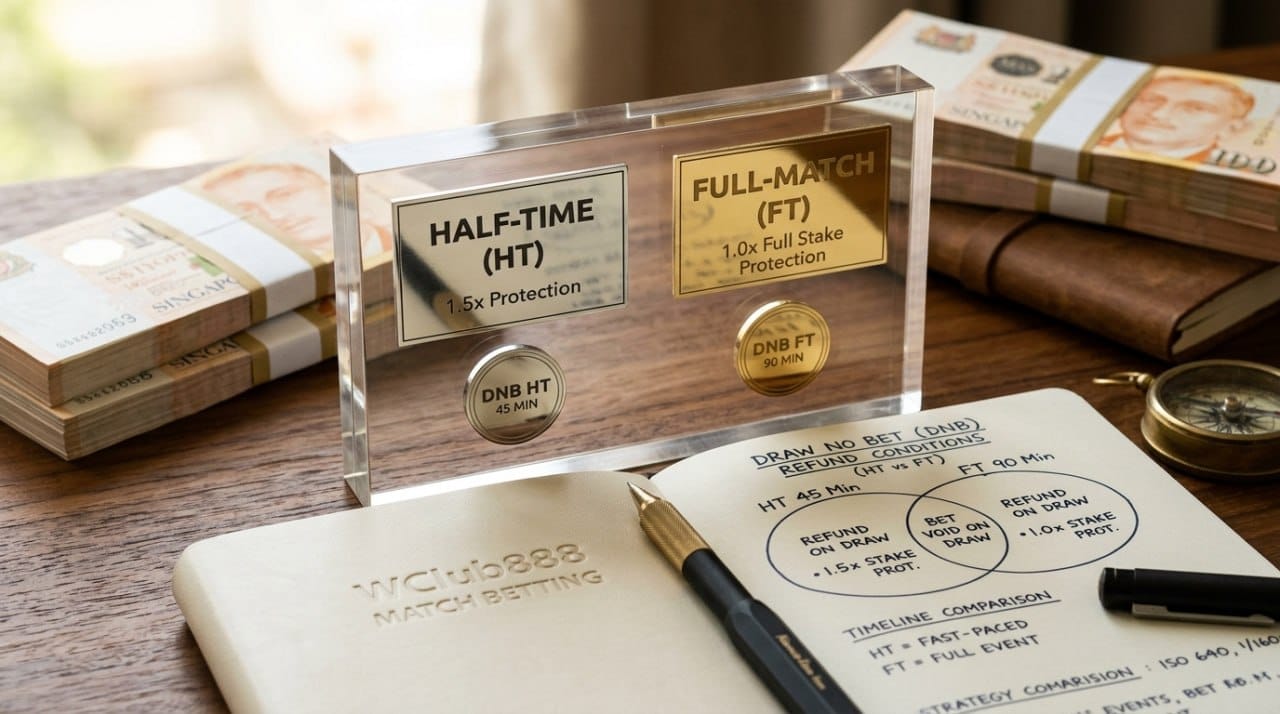
Half-time and full-time Draw No Bet may share a name, but they’re two different bets built for different match scenarios. And if you mix them up on the wrong fixture, you’ll either pay for protection you don’t need or miss it entirely when you do. But before we get into the details, you can check out the DNB markets for Half-time and Full-time side by side on WClub888.
What Is Draw No Bet, Actually?
Draw No Bet (DNB) removes the draw from the equation — so if the match ends in a draw, your stake comes back. In short, in this market, you’re betting the team and not the scoreline. It’s the closest thing to a “safe” football bet you’ll find on WClub888, which is also why it’s popular with punters who are moving past the simple bets like 1×2.
But there’s a trade-off. DNB odds are always shorter than a straight match winner because you’re paying for that draw insurance. Essentially, you’re splitting your stake between the win and the draw refund — so the bookmaker factors that into the price.
What Is Half-Time Draw No Bet And When Does It Pay Off?
Half-Time Draw No Bet (HT DNB) settles at the break. If the score’s level at that point, your money just gets returned to you. What happens after halftime? Doesn’t matter for this bet.
So when does this market actually make sense?
It works best when you fancy a team to start strong, but you’re not fully convinced they can carry that through the whole 90 minutes.
Think of it this way. You’ve got a favorite up against a disciplined underdog that’s happy to sit deep and frustrate early on. The favorite looks sharp, creates chances, and does most of the attacking in the first half. But if it’s still 0‑0 or 1‑1 at the break, your HT DNB stake just gets refunded — no harm done.
If you’ve been watching international tournaments on Singapore online sports betting platforms like WClub888, you’ll notice one thing: once a draw becomes a useful result —whether it’s enough to keep qualification hopes alive or just avoid unnecessary risk — managers tend to turn cautious after the break. Defensive subs come earlier, the pace drops, and protecting a point often matters more than pushing for three.
That’s exactly why Half‑Time Draw No Bet can be a smart option. You’re backing a team’s ability to get something done in the first half — without having to sweat what the manager does at the break.
Full Match Draw No Bet: Why Is It Suitable For Knockout Games?
Full Match Draw No Bet or Full Time Draw No Bet (FT DNB) covers the full 90 minutes plus stoppage time. If the score’s level after regulation, your stake comes back – no matter how it gets there.
This market often fits knockout football because teams can’t settle for a draw. Unlike group games where a point might be useful, knockout ties require a winner — even if it goes to extra time.
Here’s a scenario that plays out often:
The stronger side starts slowly, but as the game wears on, fatigue sets in. Managers make attacking changes, gaps appear, and the team with more quality starts carving out better chances.
And this is where Full Match Draw No Bet becomes useful. You’re giving the favorite the full match to show their quality, without the risk of losing if it’s still level after 90 minutes.
Key Note:
Extra time and penalties don’t count for standard Full Match DNB. The bet settles on 90 minutes. So you’re backing a team on WClub888 to get the job done in regulation and not gambling on a shootout.
Draw No Bet HT vs FT: Quick Comparison
| Feature | Half-Time Draw No Bet | Full-Match Draw No Bet |
| Settlement | After 45 minutes | After 90 minutes + stoppage time |
| Best for | Slow, tactical starts | Teams expected to improve over time |
| Influenced by | Early game plan | Tactical changes and late pressure |
| Commonly use | Group-stage matches | Knockout matches |
| Main advantage | Limits exposure to second-half game management | Gives stronger teams more time to win |
Here’s the quick way to separate them:
- Half‑Time DNB bets on the first 45 minutes.
- Full‑Match DNB bets on the whole game.
If you’ve read a basic draw no bet guide before, you already know the refund part. The real difference isn’t the refund — it’s when the bet actually settles.
- A Half‑Time DNB bet looks only at the scoreline after 45 minutes. That’s it.
- A Full‑Match DNB waits until the final whistle. So, whether you are staking on World Cup knockout or EPL games, extra time and penalties don’t count.
That might not sound like a big deal, but it changes how you should analyze the fixture.
Final Say
Half‑time and full‑time DNB answer two different questions about the same match. Half‑Time DNB backs a strong start without betting on how the team manages a lead. Full‑Match DNB gives the stronger side the whole 90 minutes to prove it — no extra time, no penalties, just regulation.
Not sure which one fits your fixture? Have a look at both markets on WClub888’s live betting section and compare them side by side.
FAQs:
Is Half-Time DNB Safer Than Full-Match DNB?
Not necessarily. Half-Time DNB cuts your exposure to second-half changes, while Full-Match DNB gives a stronger side more time to get the job done. Which one’s better depends entirely on how you think the match will unfold.
Why Do Some Bettors Prefer Half-Time DNB For Group-Stage Matches?
Teams get cautious when a draw helps. HT DNB focuses on the first half, before that caution kicks in.
Does Draw No Bet Mean I Cannot Lose Money?
No. You still lose your stake if your team loses within the betting period you’ve selected. The refund is only to a draw at the settlement point — whether that’s half-time or full-time.
