


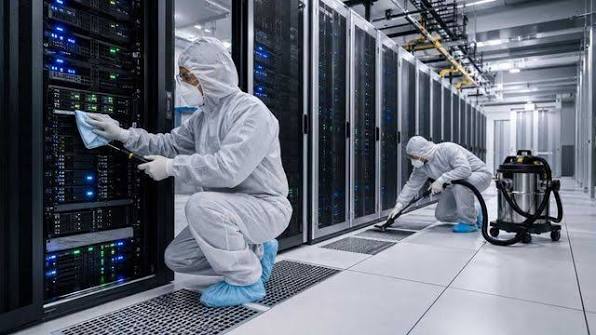
Cleaning a data hall is not a job for the regular cleaning contractor. The wrong vacuum, the wrong wipe or a floor tile lifted at the wrong moment can put more contamination into the IT equipment than it removes. Here is what separates technical data center cleaning from ordinary cleaning, and how to plan it around live operations.
Where the contamination comes from
Most contamination in a data center is not produced by the IT equipment itself. It is carried in or created in the room by the activities that keep the data center running. Knowing the sources makes it easier both to prevent contamination and to plan when cleaning is needed.
| Source | Typical contamination |
| People | Skin flakes, clothing fibres and dirt from shoes |
| Packaging | Fibres and dust from cardboard, pallets and protective materials |
| Construction and installation | Concrete dust, drilling dust and debris from cable pulling and fit-out |
| Cooling air | Particles and gases from outside air that pass through or around the filters |
| Raised floors | Zinc whiskers from zinc-coated tiles, stringers and pedestals |
ASHRAE recommends unpacking new equipment outside the data hall. It is one of the simplest and most effective measures available, because cardboard is among the biggest sources of fibres in a room that otherwise has no need for them.
Why ordinary cleaning makes things worse
An ordinary commercial vacuum cleaner captures the coarse dirt but blows the fine particles back into the air, where the cooling system carries them straight into the servers. Ordinary paper wipes shed fibres, and general-purpose detergents can leave residues that become conductive or corrosive.
This is the core difference between ordinary cleaning and technical data center cleaning. Every method is chosen to remove particles without releasing them back into the air or creating new risks for the equipment.
| Ordinary cleaning | Technical data center cleaning |
| Commercial vacuum that releases fine dust | HEPA-filtered vacuum that captures at least 99.97 % of particles at 0.3 µm |
| Paper or cellulose wipes that shed fibres | Lint-free wipes that leave no fibres behind |
| General-purpose detergents | Non-ionic, pH-neutral cleaning agents that leave no conductive or corrosive residue |
| No set order of work | Top-down sequence so dust falls onto surfaces that have not yet been cleaned |
| No awareness of static electricity | Procedures that prevent electrostatic discharge near sensitive electronics |
The subfloor needs its own plan
In a data center with a raised floor, the subfloor is not just a cable route. It is the duct that carries cold air to the racks, so whatever lies there ends up in the IT equipment sooner or later. At the same time, it is the area where cleaning carries the highest risk.
When tiles are lifted, the data hall must be kept at positive pressure relative to the section of the subfloor being cleaned. Otherwise, dust from the plenum is drawn up into the room and into the servers. Lifting tiles and handling cables can also release zinc whiskers, so the work should be done section by section and only by people who know the risk.
How often should a data center be cleaned?
No standard prescribes a cleaning interval for data centers. ISO 14644-1 and ASHRAE’s guidelines define the result – how clean the air must be – not how often to clean to achieve it. Any supplier that quotes a fixed interval as a requirement is therefore stating a preference, not a norm.
The right interval is the one the measurements support. Start with a baseline particle count, set an interval based on the result, and adjust it as new measurements come in. Some events also call for extra cleaning, regardless of the regular schedule.
| Event | Why it calls for cleaning |
| Construction or renovation work | Fine construction dust spreads far beyond the work area |
| Installation of new racks or equipment | Packaging, drilling and cable work release fibres and dust |
| Work in the subfloor | Lifted tiles and cable pulling disturb settled dust and zinc whiskers |
| Filter failure or change of cooling system | Unfiltered air may have carried contamination into the room |
| Commissioning and handover | The data hall should be documented clean before IT equipment goes into operation |
Document the result, not just the effort
A cleaning log shows that the work was done. Only measurements show that it worked. When choosing a supplier, it is therefore worth asking how the result is documented, not only how the cleaning is carried out.
| Ask the supplier | What a good answer includes |
| How do you document the result? | Particle counts before and after, measured according to ISO 14644-1 |
| Which equipment do you use? | HEPA-filtered vacuums, lint-free wipes and suitable cleaning agents |
| How do you work in the subfloor? | Section-by-section work with controlled airflow and pressure |
| How do you protect live equipment? | Procedures for electrostatic discharge and work near running systems |
| Who carries out the work? | Trained staff with a supervisor who is responsible for the method and the result |
A data hall that is measured, cleaned and measured again is a data hall where contamination is a managed risk rather than an unknown one. That is ultimately what facility management is about.
Gabriell Summerland is an authorised electrical contractor and CEO of Bluecircle, a Danish company specialising in critical power, commissioning and technical cleaning of data centers.