


Starting a business has never been easier on paper. You can register a company online in an afternoon, open a business bank account from your phone and launch a website before dinner. Yet the number of new owners who stall in their first year has not dropped much, and the reasons are usually the same: a skipped legal step, money mixed between personal and business accounts, no plan for cash flow, or a growth push that starts before the basics are in place.
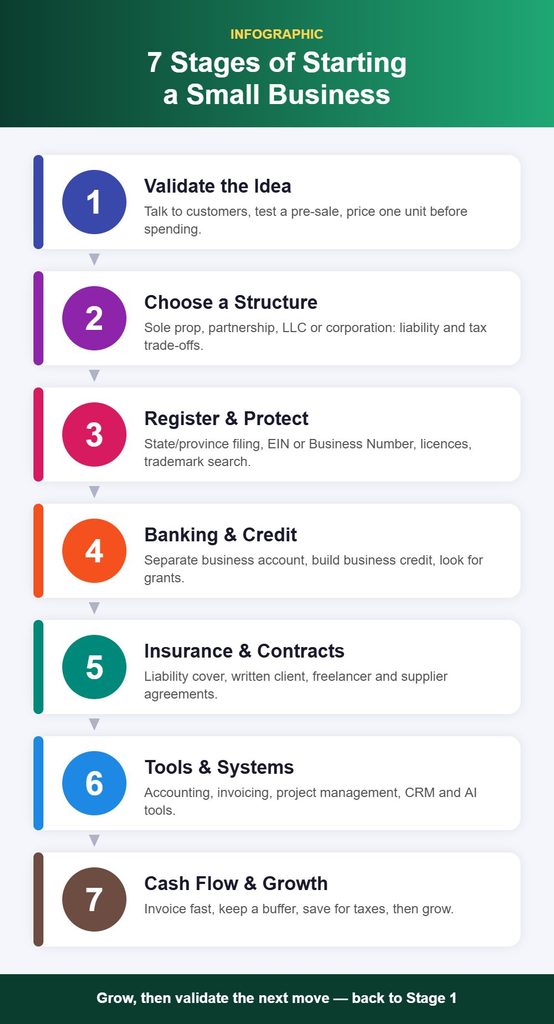
This guide lays out the whole journey as one visual checklist. The infographic below shows the seven stages most small businesses move through, from testing an idea to building systems that let the company grow. After it, each stage is explained in plain language, with the questions to answer before you move on.
Why a Checklist Beats a Business Plan Nobody Reads
Traditional business plans still have a place, especially when you are applying for a loan or pitching investors. But for most founders, a fifty-page document goes stale within weeks. A checklist works differently. It tells you what to do next, shows what you have already covered and makes gaps obvious. It also stops the most common early mistake: spending money on branding, ads or software before the legal and financial foundations are ready.
The Infographic: 7 Stages from Idea to Growth
Each stage builds on the one before it. You can work on several at once, but skipping one usually costs time or money later.
Stage 1: Validate the Idea Before You Spend
An idea becomes a business when someone is willing to pay for it. Before registering anything, test demand cheaply:
- Talk to at least ten potential customers about the problem you want to solve.
- Look at competitors. Their existence is usually a good sign, because it proves a market exists.
- Offer a pre-sale, a pilot or a simple landing page with a waiting list.
- Work out a rough price and the cost of delivering one unit or one hour of service.
If nobody will pay, adjust the offer now. It is far cheaper than adjusting it after you have bought equipment or signed a lease.
Stage 2: Choose a Business Structure
The structure you choose affects taxes, personal liability and paperwork. In the US the common options are a sole proprietorship, a partnership, a limited liability company (LLC) and a corporation. In Canada, founders typically choose between a sole proprietorship, a partnership and a federal or provincial corporation.
A sole proprietorship is the simplest, but it offers no separation between you and the business: if the business owes money, so do you. An LLC or corporation creates that separation and can make you look more established to clients and lenders, at the cost of more filings. Many owners start simple and convert later, but if you are taking on clients with significant contracts or any physical risk, getting liability protection early is worth considering. An accountant can help you compare the tax side for your situation.
Stage 3: Register and Protect Your Name
Once you know the structure, register the business with your state or province and get any tax numbers you need, such as an Employer Identification Number (EIN) in the US or a Business Number in Canada. Check whether your city or industry requires specific licences or permits.
This is also the moment to think about your brand name. Registering a company name with the state does not give you exclusive rights to it nationwide. A trademark does. Search existing trademarks before you invest in a logo, packaging or a domain, and consider filing for protection once you are confident in the name. Rebranding after a dispute is one of the most expensive avoidable mistakes a small business can make.
Stage 4: Separate Your Money and Build Business Credit
Open a dedicated business bank account as soon as the business is registered. Mixing personal and business money makes bookkeeping painful, weakens the liability protection of an LLC or corporation and makes tax season far more stressful.
Next, start building business credit. A business credit profile lets you qualify for loans, credit lines and better supplier terms without relying only on your personal credit. Simple steps help: get a business credit card and pay it in full, open accounts with suppliers that report to business credit bureaus and keep your business details consistent everywhere they appear.
Keep an eye out for grants as well. Many local governments, chambers of commerce and private foundations offer small business grants, particularly for specific industries, regions or founder groups. They take time to apply for, but they are money you do not have to pay back. You can read more here about the financing and setup topics that come up most often for new owners.
Stage 5: Get Insured and Put Agreements in Writing
Insurance is easy to postpone and painful to lack. The core policies most small businesses look at are general liability, professional liability (also called errors and omissions) for service businesses, commercial property and, once you hire, workers’ compensation. A broker can help match coverage to your actual risks rather than selling you everything.
Contracts matter just as much. Every regular relationship should be on paper: client agreements, freelancer and contractor agreements, partnership terms and supplier terms. A good contract sets out the scope of work, payment terms, deadlines, ownership of anything created, confidentiality and what happens if either side wants to end the arrangement. Templates are a reasonable starting point, but have a lawyer review the agreements your business depends on most.
Stage 6: Set Up Tools and Systems
The right software saves hours every week, while the wrong stack creates subscription costs and confusion. Focus on a few essentials first:
- Accounting software connected to your business bank account.
- Invoicing and payments so clients can pay online quickly.
- Project management for tracking tasks, deadlines and client work.
- A simple CRM or even a well-organised spreadsheet to track leads and customers.
- AI tools for drafting emails, summarising documents and handling routine writing, used with care for anything client-facing.
Choose tools that integrate with each other, start on free or basic tiers, and review your subscriptions every few months.
Stage 7: Manage Cash Flow and Plan Growth
Profitable businesses still fail when they run out of cash. Cash flow is the timing of money in and money out, and it deserves its own weekly habit:
- Invoice promptly and set clear payment terms.
- Follow up on late payments in a consistent, polite way.
- Keep a cash buffer that covers at least a few months of fixed costs.
- Set aside money for taxes every time you get paid.
- Track which business expenses are tax-deductible so you do not overpay.
Once cash flow is steady, growth becomes a choice rather than a gamble. That might mean hiring, adding a product line, entering a new market or investing in marketing. Whatever you choose, go back to Stage 1 and validate it first.
How Long Does Each Stage Take?
There is no fixed timetable, but most solo founders and small teams can move through the first five stages in a few weeks if they work on them steadily. Validation can take anywhere from a few days to a couple of months, depending on how quickly you can reach real customers. Registration and tax numbers are often done within days, while a trademark application can take many months to be examined, which is another reason to file early. Banking, insurance quotes and contract templates usually fit into a single focused week.
Stages six and seven never really finish. Your tools will change as the business grows, and cash flow management becomes a permanent routine rather than a one-time task. The goal is not to complete the checklist and forget it, but to revisit it every quarter and ask which stage needs attention now.
Common Mistakes to Avoid
- Branding before validating. A beautiful logo will not sell an offer nobody wants.
- Using a personal account for business. It complicates taxes and undermines liability protection.
- Skipping the trademark search. A forced rebrand can wipe out years of brand-building.
- Working on handshakes. Unwritten agreements are the source of most client disputes.
- Ignoring cash flow until it is a crisis. A weekly fifteen-minute review prevents most surprises.
A 30-Day Launch Plan
- Week 1: Validate the idea with real conversations and a simple offer.
- Week 2: Choose your structure, register the business, get your tax number and run a trademark search.
- Week 3: Open a business bank account, arrange insurance and prepare your core contracts.
- Week 4: Set up accounting, invoicing and project tools, create a cash flow sheet and land your first paying customer.
Where to Keep Learning
Every stage on this checklist has its own details, from which deductions apply to your business to how to compare project management software. Small business resource sites that focus on setup, legal basics, finance and software are a good place to dig deeper; GrowBizLab is one such blog covering contracts, insurance, trademarks, business credit, grants, cash flow and business tools. If any of these stages is where you are right now, learn more before you make the decision.
Final Thoughts
Starting a small business is a sequence of manageable decisions rather than one giant leap. Validate first, set up the right structure, protect your name, separate your money, get insured, put agreements in writing, choose a few good tools and watch your cash flow. Keep the infographic above as your checklist, tick off each stage as you go, and you will build on solid ground instead of fixing cracks later.