


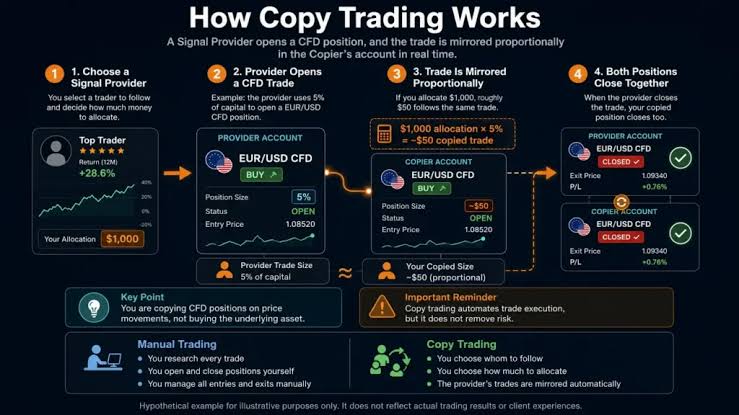
Copy trading sounds simple. You find another trader whose approach you like, connect your account to theirs, and your account opens and closes positions in step with them. For people who are curious about the markets but short on time or experience, the idea is appealing. It also raises fair questions. Who are these traders? How are they paid? What happens when they have a bad month? And how do you stop one person’s mistake from emptying your account?
This explainer breaks copy trading down into its moving parts. It looks at how copy trading platforms are usually structured, how allocation and fees tend to work, which statistics deserve attention and which ones can mislead, and how to set limits so that the experience stays educational rather than painful.
The Basic Mechanics
Most copy trading services have two types of users. Strategy providers, sometimes called signal providers or master traders, trade their own accounts and allow others to follow them. Followers, or copiers, choose one or more providers and allocate part of their balance to each. When the provider opens a trade, the platform opens a proportional trade in the follower’s account. When the provider closes it, the follower’s position closes too.
The word “proportional” is doing a lot of work here. Platforms use different methods to size copied trades. Some scale positions according to the ratio between the follower’s allocated funds and the provider’s account equity. Some let the follower set a fixed lot size or a multiplier. Others offer a mix. The method matters, because it decides how much you actually risk on each copied trade, and two followers copying the same provider can end up with very different results.
What You Are Actually Trading
At many online brokers, copy trading runs on top of CFD accounts. That means the positions copied into your account are leveraged contracts on forex, metals, indices or other markets, not direct ownership of the underlying assets. Leverage applies just as it would if you placed the trades yourself. A provider using a large position size relative to their equity can generate big swings, and those swings flow straight into your account.
It is worth saying plainly: following someone else does not make leveraged trading safer by default. Most retail traders who trade CFDs lose money, and that includes people who copy others. Copy trading changes who makes the decisions. It does not change the nature of the product.
How Providers Get Paid
Understanding the incentives behind a strategy helps you judge it. Common fee models include:
- Performance fees. The provider takes a percentage of net profits generated for the follower, often calculated using a high-water mark so they are not paid twice for recovering earlier losses.
- Subscription fees. A fixed monthly charge for access to the strategy, regardless of results.
- Volume-based rewards. The provider earns based on how much followers trade. This model can encourage frequent trading, which is worth keeping in mind.
- No direct fee. Some platforms do not charge followers a provider fee at all, though normal trading costs still apply.
On top of any provider fee, you still pay the usual trading costs on each copied position: spreads, commissions where they apply, and overnight swaps. Read the fee page of any platform carefully and estimate costs for a typical month before you start.
Reading a Provider’s Track Record
Copy trading platforms usually show a profile for each provider with charts and statistics. These are helpful, but they need careful reading.
Total return is the number that gets attention, and it is the least useful on its own. A provider can post a large return over a few months by taking huge risks, and the same approach can lose most of the account in a week. Look at return alongside time and risk.
Maximum drawdown shows the largest peak-to-trough fall in the account. It is one of the most important figures on the page. If a provider has had a 50 percent drawdown before, assume it could happen again while you are following.
Length of history matters a lot. A few weeks of trading proves very little. Look for providers with a longer record that includes different market conditions.
Average holding time and number of trades tell you about style. A provider who opens hundreds of short trades will generate more trading costs than one who holds a handful of positions for days.
Open positions and floating loss deserve a look too. Some strategies show a smooth equity curve because they hold losing trades open for long periods rather than closing them. A large floating loss can be a warning that the curve is not telling the full story.
Strategies That Look Better Than They Are
Two common patterns catch new followers out. The first is the martingale or grid approach, where a trader adds to a losing position at set intervals, expecting price to come back. This tends to produce many small wins and a steady-looking chart, until a strong trend causes a very large loss in one go. The second is the short, spectacular run. A provider takes oversized bets, gets lucky for a few weeks, rises to the top of the leaderboard, attracts followers and then gives the gains back.
Analysts often note that leaderboards reward recent performance, which can push the riskiest strategies into the spotlight. Sorting by drawdown or by length of track record, rather than by return, is a simple way to see a different picture.
Setting Your Own Limits
The best protection in copy trading is the set of limits you control. Most platforms let you apply some of the following:
- Allocation cap. Decide how much of your total capital goes to copy trading and how much to each provider. Many cautious users keep any single provider to a small slice.
- Stop-loss on the copy relationship. Some services let you stop copying automatically if the allocated funds fall by a set percentage.
- Lot size or multiplier controls. These stop copied trades from becoming larger than you are comfortable with.
- Instrument filters. If you do not want exposure to a particular market, check whether you can exclude it.
- Diversification. Following two or three providers with different styles can reduce reliance on any one person, although it does not remove market risk.
Set these limits before the first copied trade, not after a loss. It is much easier to make calm decisions in advance.
Choosing a Platform Itself
Beyond the providers, the platform and broker behind the service matter. Check which regulated entity holds your account and confirm it on the regulator’s public register. Look at how transparent the provider statistics are, whether trade history can be viewed in detail, how fees are displayed, and whether you can stop copying and close positions instantly. It also helps if the copy trading service works alongside standard platforms such as MetaTrader, so you can see copied positions in a familiar interface.
As one example, Ultima Markets runs a copy trading platform that lets users follow the strategies of other traders, alongside CFD trading on forex, metals and other markets via MetaTrader 4, MetaTrader 5, WebTrader and its mobile app. For EU clients, its affiliated entity Ultima Markets Cyprus Ltd is regulated by the Cyprus Securities and Exchange Commission. Whichever service you consider, check its regulation and the terms that apply in your country yourself.
Using Copy Trading as a Learning Tool
Copy trading tends to work best for people who treat it as a way to learn rather than a way to hand off responsibility. Watching how an experienced trader enters, manages and exits positions can teach you a lot about risk control, patience and trade management. Ask yourself why each copied trade was opened, and keep notes. Over time you may find that you understand the market better and want to make more of your own decisions.
It also pays to review your copy relationships regularly. Once a month, look at each provider’s recent drawdown, whether their style has changed, and whether their results still match what you signed up for. A provider who suddenly starts trading much larger sizes or a new market is worth a closer look.
Common Questions
Can I lose more than I allocate? That depends on the platform’s rules and your account protections. Some jurisdictions require negative balance protection for retail clients. Check the terms and use stop-loss controls on the copy relationship.
Do I need to monitor the account? Yes. Copy trading reduces the time spent on analysis, but it does not remove the need to check your account, your limits and your providers.
Is a top-ranked provider a safe choice? Not necessarily. Rankings often reflect recent returns, which can come from high risk. Look at drawdown and history first.
Summing Up
Copy trading can be an interesting way to take part in the markets and to learn from others. It is still leveraged trading with real money, and it carries the same risks. Understand how positions are sized, what you pay, how to read a provider’s statistics, and how to cap your exposure. Treat any track record with healthy skepticism and keep your allocations modest.
Risk warning: Copy trading involves leveraged CFD products, and you can lose money quickly. A strategy provider’s past performance is not a reliable indicator of future results. This material is general education and is not financial advice or a recommendation to follow any trader.