


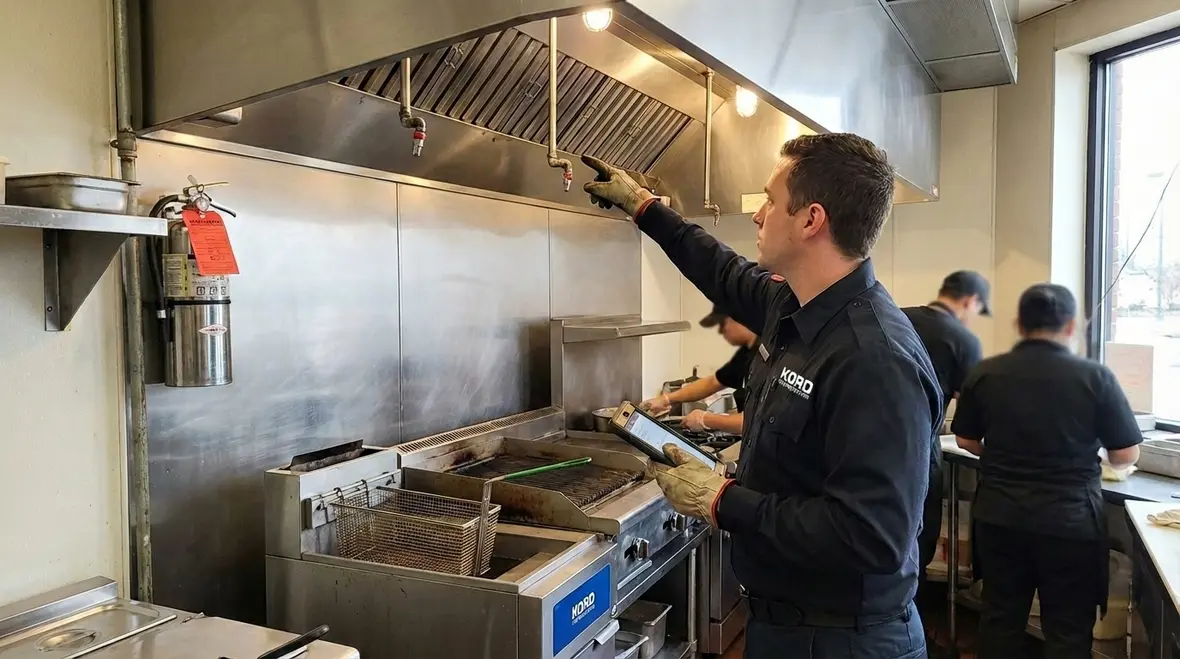
The suppression system above a commercial cook line is the piece of equipment an operator thinks about least and depends on most. It sits there for years doing nothing visible, gets inspected by someone who leaves a tag and a report, and receives attention only when an inspector flags it or a fire actually starts.
That inattention is understandable and expensive. Kitchen fires start at the appliances, spread into the hood and duct where the grease is, and move through the building from there. The suppression system is the thing standing between a flare-up on a fryer and a total loss, and there are a handful of ways it quietly stops being able to do that job.
What the System Actually Does
A hood suppression system is a pre-engineered assembly of nozzles positioned over specific appliances and inside the hood and duct, fed by a wet chemical agent from a cylinder, and triggered by fusible links in the hood or by a manual pull station.
When it activates, several things happen at once. The agent discharges through the nozzles, coating the cooking surface and reacting with hot grease to form a soapy layer that seals the surface and blocks oxygen. Simultaneously, the system should shut down the fuel or power to the appliances beneath the hood, because agent discharged onto a burner that is still firing is fighting a fire that keeps being relit.
That fuel shutoff interlock is the component most often found disconnected, bypassed, or never reconnected after a repair. It is worth asking about specifically, since a system that discharges but does not kill the gas has only done half its job.
UL 300 and Why Older Systems Were Replaced
Kitchen suppression changed substantially when cooking did. As commercial kitchens shifted toward vegetable oils and higher-efficiency appliances that hold heat longer, the dry chemical systems that had been standard proved inadequate against the resulting fires, which could reignite after the agent was spent.
The UL 300 standard governs the wet chemical systems that replaced them, and compliance is the expectation for commercial cooking operations. Systems predating that standard are generally not serviceable and need replacement rather than repair.
The practical implication arises when buying or leasing an existing restaurant space. A system that looks intact may be obsolete, and discovering that during a pre-opening inspection is an expensive surprise on a timeline that has no slack in it. Establishing what is above the hood, and when it was installed, belongs on the due diligence list alongside the lease terms.
Nozzle Placement Is Tied to Your Specific Equipment
This is the point that catches the most operators, and it is worth stating plainly: the system was engineered for the appliances that were under the hood on the day it was installed.
Nozzles are selected and aimed for particular appliance types in particular positions. Move the fryer, swap a griddle for a charbroiler, add a wok range, or slide the line over eighteen inches to fit new equipment, and the coverage no longer matches the hazard. The system still looks correct. The tag is still current. And the nozzle that was aimed at a fryer vat is now pointed at empty stainless steel.
Any of these should trigger a call to the suppression contractor:
- Replacing an appliance with a different type
- Repositioning equipment along the cook line
- Adding equipment beneath an existing hood
- Removing an appliance, which leaves a nozzle covering nothing while another hazard may be uncovered
- Any change in cooking medium or method that alters the hazard
Menu changes matter more than owners expect, because the hazard classification follows what is being cooked and how, not simply what the appliance is called.
The Inspection Schedule and What It Covers
Commercial kitchen suppression systems require professional inspection on a semiannual basis, and the visit is more involved than a look and a tag. A proper inspection covers the agent cylinder and its pressure, the condition and date of the fusible links, nozzle position and whether the protective caps are intact, the piping and detection line, the manual pull station and its accessibility, and the fuel shutoff function.
Two items deserve particular attention between visits. Nozzle caps keep grease out of the nozzle orifice, and a nozzle clogged with baked-on grease may not discharge properly. Kitchen staff sometimes remove caps during cleaning and do not replace them. And the manual pull station has to remain unobstructed and reachable on the path out of the kitchen, which is exactly where a rolling rack tends to end up during a busy service.
Deficiencies noted on an inspection report are not suggestions. An open deficiency list at the time of a fire is a document that will be read closely afterward by an insurer and possibly by others.
Hood Cleaning Is a Separate Obligation
Suppression service and hood cleaning are different services, often from different vendors, and operators regularly assume one covers the other.
Hood and duct cleaning removes the grease accumulation that turns a small appliance fire into a structure fire. Required frequency depends on cooking volume and the type of cooking, with high-volume solid fuel operations needing far more frequent attention than a low-volume kitchen. Cleaning should extend through the entire system, from the hood through the duct to the exhaust fan, since a certificate covering only the visible hood interior leaves the actual fire path untouched.
Coordinating the two matters. Cleaning crews work directly around detection lines, fusible links, and nozzles, and damage or displacement during cleaning is a known source of problems found at the next inspection.
The Class K Extinguisher Is Not Optional
The hood system handles the appliances under the hood. A portable extinguisher rated for cooking media, meaning a Class K unit, covers what the hood system does not and gives staff a means to address a small fire before it becomes a discharge event.
Ordinary dry chemical extinguishers are not appropriate for cooking oil fires and can make them worse. The Class K unit should be mounted along the path of egress from the cooking area rather than behind the line, and travel distance from the hazard is limited by code. Staff need to know where it is and that it is used after the hood system, not instead of it.
After a Discharge
A system that has discharged is spent and offers no protection until it is professionally recharged and reset. The kitchen should not resume cooking under that hood until it has been.
The sequence is straightforward: confirm the fire is out and the fuel is off, evacuate and call the fire department even if the fire appears controlled, contact the suppression contractor for recharge and inspection, and clean the wet chemical residue from all surfaces, since the agent is corrosive to some finishes if left in place. The contractor should also determine why the system activated, because an accidental discharge from a damaged detection line points to a problem that will recur.
Anyone servicing these systems should be working to NFPA standards and to the requirements of the local authority having jurisdiction. Crimson Fire Protection installs, inspects, and repairs UL 300 kitchen hood suppression systems for restaurants and commercial kitchens in Casper and across Wyoming, alongside fire extinguisher service, emergency exit lighting, and industrial suppression, and holds membership in NAFED and NFPA. Whichever contractor an operator uses, the report should arrive with a clear deficiency list rather than only a tag.
Key Takeaways
- The fuel shutoff interlock is as important as the agent discharge, and it is commonly found bypassed after a repair.
- Pre-UL 300 systems generally cannot be serviced and need replacement, which matters when taking over an existing space.
- Nozzles are engineered for the specific appliances in specific positions, so moving or changing equipment invalidates the coverage.
- Professional inspection is semiannual and should produce a deficiency list, not just a tag.
- Nozzle caps and an unobstructed manual pull station are the two things staff most often compromise between visits.
- Hood cleaning is a separate service, and cleaning crews are a known source of displaced detection components.
- A Class K extinguisher is required alongside the hood system; ordinary dry chemical units are wrong for cooking oil.
Frequently Asked Questions
How often does a kitchen suppression system need inspection?
Semiannual professional inspection is the standard requirement for commercial cooking systems, with additional service after any discharge and whenever equipment beneath the hood changes. The local authority having jurisdiction may impose additional requirements, so the inspecting contractor should confirm what applies locally.
Can I move a fryer without calling the suppression company?
No. Nozzle placement is tied to appliance type and position, and relocating equipment can leave a hazard uncovered even though the system appears untouched. The same applies to swapping in a different appliance type or adding equipment under an existing hood.
Does the hood system replace the need for extinguishers?
It does not. The hood system covers the appliances beneath it and the duct, while portable extinguishers cover everything else in the space and give staff an option for a small fire. A Class K unit is specifically required where cooking oils and fats are used.
What happens if an inspection finds deficiencies?
The deficiencies are documented and should be corrected promptly. An open list creates exposure with the authority having jurisdiction and, more consequentially, with an insurer if a loss occurs while known problems remain unaddressed. Correction dates are worth tracking in the same place as the inspection records.
Is the suppression system connected to the fire alarm?
In many installations it is, so that activation notifies occupants and, where monitored, generates a response. Requirements depend on the building and local code. It is worth confirming what happens on activation rather than assuming someone is notified automatically.
Who is responsible in a leased space, the tenant or the landlord?
Lease language varies considerably, and both arrangements are common. What matters is that responsibility is assigned explicitly rather than assumed, since a system nobody has scheduled inspection for is a system that will fail an inspection. This is worth clarifying in writing before opening rather than after a citation.
Conclusion
Kitchen suppression fails quietly. The system does not announce that a nozzle no longer points at the fryer, or that the gas valve stopped being interlocked during a repair two years ago. Those conditions are found either at an inspection or during a fire, and the difference between those two discoveries is the entire value of taking the system seriously between visits.
