


Introduction
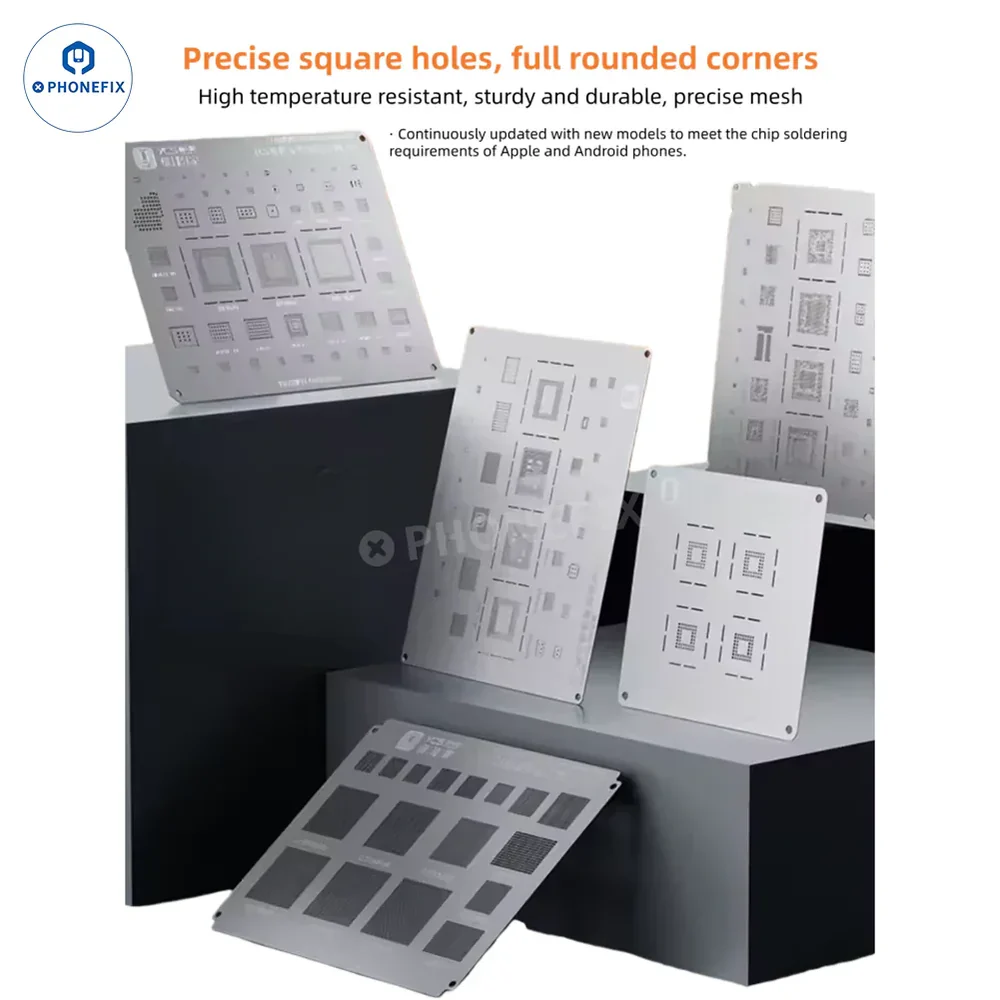
The iPhone 17 features a more complex motherboard structure and higher component density, significantly increasing the difficulty of imaging and hardware repairs. Common issues include detached solder pads, thermal damage, and the challenge of removing underfill—demanding extremely precise temperature control and microscopic manipulation skills. Repairs necessitate the use of specialized tools and robust techniques—such as YCS Mobile BGA Reballing Stencils, solder paste, and high-magnification microscopes—to ensure both precision and safety. By combining standardized procedures with reliable equipment, repair professionals can effectively mitigate risks and boost the success rate of repairs.
Understanding Common Micro-Soldering Problems in the iPhone 17 Series
The iPhone 17 motherboard configuration uses noticeably included chips and a multi-layer PCB arrangement that booms processing issues. One of the most common problems technicians encounter is a weak or cracked solder joint as a result of drops, overheating, or construction stress. Because the components are exceptionally small, even the slightest mistake in soldering can completely damage the sense board.
Another essential feature is temperature control all through chip removal and replacement. Many restoration novices notice asymmetric hot air to the IC all at once, which can distort the board or melt nearby plugs. Commercial technology typically uses controlled airflow between 320°C and 380°C, depending on tile type and board thickness. The hot air should circulate around the IC in a circular motion as opposed to focusing around the unmarried agent. Micropoint ESD-safe tweezers are encouraged when lifting tiles because they provide greater control and reduce the risk of pad loss throughout the finishing process .
Preparing the Workspace and Essential Repair Equipment
A successful iPhone motherboard repair starts with proper practice. Before installing the equipment, technicians should prepare a clean antistatic work area with live lighting and proper ventilation. Because the iPhone 17 platforms have delicate microconnectors, the use of an antistatic mat and grounding strip allows you to protect against electrostatic discharge loss. Precision screwdrivers, ceramic tweezers, PCB holders, heat-resistant tape, and quality flux are also important for safe repair work.
High-definition visual inspection equipment is particularly important in the context of microwelding operations. Mr.Yang gets access to technicians to finally inspect solder joints, small capacitors, and damaged voltages with eighty-five Ultra HD microscope first-class readability. It allows microscopy to reduce eye strain and improve solder accuracy when running advanced iPhone 17 Repair Tools. YCS Mobile BGA Reballing Stencils for BGA Reballing Processes provides precise ball alignment that improves chip layout quality and reduces solder bridge problems. Combined with YCS Solder Paste, technicians can achieve stronger solder joints with smoother sections and better conductivity during the time that switching tasks are
Safe Disassembly and Underfill Removal Techniques
Taking down the iPhone 17 collection requires durability as the internal structure has more powerful adhesives, tightly connected flex cables Before starting the machine, the technicians need to heat the edges of the screen evenly to about eighty°C using a heating pad or heated airflow factor or they will mix in the necessary airflow plug without problems. Plastic starter gear and suction cups are a safe choice all through screen separation.
One of the most difficult repair strategies involves Underfill Removal round CPU and NAND chips. The underfill adhesive protects the tiles from physical stress, but also makes the choice of tiles unusually difficult. Often, technicians melt the underfill to add hot air controlled between 340°C and 360°C with moderate airflow. A thin fine blade or curved precision tweezers can then gently scrape the softened underfill away from the chip edge. Choosing a high-quality flux is important because it improves heat transfer and reduces oxidation during the process. Many experts choose sticky felt because it stays in the role and keeps the solder joints close by heating up the board.
Detailed Micro-Soldering and Chip Replacement Process
After preparing the board and removing the broken tile, the next step is to clean the solder pads nicely. To stop vintage solder from the PCB surface, use a soldering iron with cozy ten cone and lead solder. The temperature of a proper soldering iron is generally between 350°C and 380°C depending on shipping conditions. The copper wick blends with the current and lightens smoothly on clean tracks without bad tracks. Technicians need to avoid applying too much stress, as a raised cushion can cause additional treatment problems.
Once the board is clean, gently re-round it before installing the tile. YCS Mobile BGA Reballing Stencils are commonly used due to the fact that they provide precise alignment for small solder balls and increase stability at all stages of chip preparation After placing the stencil on the chip, technicians playfully apply YCS Solder Paste through a metal hole scraper. Hot air is then continued until the solder balls are properly formed. During chip installation, Mr.Yang will quietly preheat the board while checking the alignment under the eighty-five Ultra HD Microscope. As soon as the solder reaches its melting temperature, the chip should clearly settle, and technicians should never press directly on the IC as long as the recirculation exists, as this can create short circuits under the chip .
Preventing Damage During Advanced iPhone Motherboard Repair
Many motherboard failures occur due to overheating or poor temperature management at some stage of processing. Technicians must often protect high-temperature Kapton tape or metal heat shields using additives before using hot air Face ID circuits, electrical control ICs, NAND storage chips and other sensitive areas can fail completely if exposed to asymmetric heat low temperatures because the current can be lost as temperature controlled fans and condensers can resistors.
Another important treatment task is to decide on the appropriate tweezers and solder supplement. Curved ESD-safe tweezers provide excellent visibility when lifting tiles, while apparently Class I tweezers do a good job of properly placing micro-connectors Flow detection also affects the treatment satisfactorily enough. Low-micro-current can leave corrosive debris and sensitive solder joints, while top-grade current improves solder fit with current and reduces oxidation Technicians using professional systems from DIYFIXTOOL often have greater stability because better treatment of gear fixed temperatures, accurate microscopic management through complex Proco micro-soldering.
Testing, Verification, and Reassembly After Repair
After the soldering is complete, technicians should carefully examine the treated area under magnification before powering up the machine. The Mr.Yang 85 Ultra HD microscope can identify ischemic joints, solder bridges, missing additives or damaged pads that are not visible to the naked eye. A multimeter shall also be used for continuity tests and to verify that there are no fast circuits around the part being repaired. This checking out step is important because even a small solder bridge can cause significant motherboard failure after reassembly.
Once the authentication is complete, the iPhone 17 motherboard can be gently inserted back into the case. Battery connectors should always be attached last to reduce the risk of electricity in a connection. Technicians should look at charging, display reaction, Face ID, camera, Wi-Fi, and speaker functionality before completely sealing the device. Appropriate adhesive replacement across the display bezel additionally allows for the restoration of dust and moisture resistance. A very final pressure test on the charge cycle and temperature monitoring can verify if the regeneration is stable and has long-term device performance success.
Conclusion
Repairing the logic boards of the iPhone 17 series requires high-precision micro-soldering and strict temperature control, encompassing steps such as chip removal, adhesive cleaning, and BGA reballing; even a minor oversight can easily result in permanent damage to the motherboard. By utilizing professional tools—including YCS reballing stencils, solder paste, and high-magnification microscopes—in conjunction with DIYFIXTOOL repair equipment, both soldering precision and success rates can be significantly enhanced. Adhering to standardized procedures and conducting rigorous post-solder inspections ensures the efficient completion of complex motherboard repairs while guaranteeing stable performance.
