


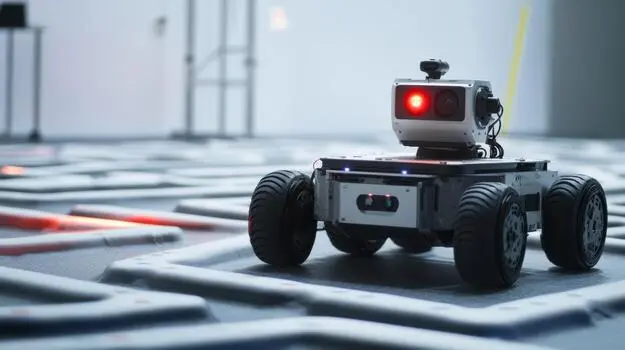
Walk into a modern warehouse and pay attention to the floor for a moment. You might notice something unusual. Small robotic platforms glide past shelves, changing direction with surprising confidence, avoiding obstacles without hesitation, and carrying products from one end of the facility to another. Nobody is steering them. Nobody is giving them step-by-step instructions. They simply move, calculate, adapt, and continue their task.
There is something strangely fascinating about mobile robots. Unlike traditional industrial machines that stay fixed in one place, these systems move through the world. They navigate uncertainty. They encounter obstacles. They make decisions in real time. In a way, they bring robotics closer to the messy reality that humans deal with every day.
What makes mobile robots especially interesting is that they are no longer confined to research laboratories or futuristic demonstrations. They are quietly entering warehouses, hospitals, farms, airports, military operations, and even public spaces. Many people interact with the results of their work without realizing it. The package arriving at your doorstep, the inventory stocked in a retail store, or the medical supplies delivered within a hospital may have been handled by a mobile robot somewhere along the journey.
More Than Machines on Wheels
When people hear the term “robot,” they often imagine humanoid machines walking around like characters from science fiction films. The reality is both less dramatic and, arguably, more impressive. Most mobile robots do not look human at all.
They are designed around function rather than appearance. Some resemble compact carts. Others look like autonomous vehicles. Certain systems operate in the air as drones, while others navigate underwater environments. Their defining characteristic is not their shape but their ability to move independently through changing surroundings.
That capability requires an extraordinary combination of technologies. Sensors, cameras, lidar systems, artificial intelligence, mapping software, and onboard computing work together continuously. Every movement involves thousands of calculations occurring behind the scenes. The result feels almost effortless from the outside, which is often the hallmark of sophisticated engineering.
Why Businesses Are Embracing Mobile Robotics
The growing interest in mobile robots is not difficult to understand. Organizations across industries face increasing pressure to improve efficiency while managing labor shortages, rising operational costs, and growing customer expectations. Mobile robots offer a practical response to many of these challenges.
In warehouses, they reduce the time workers spend walking between locations. In hospitals, they transport medications, laboratory samples, and supplies. On farms, they assist with monitoring crops and collecting data about field conditions. At large airports, robotic systems are beginning to support logistics and maintenance activities.
What stands out is that many successful deployments focus on collaboration rather than replacement. Contrary to popular fears, mobile robots are often introduced to handle repetitive transportation tasks, allowing people to focus on work that requires judgment, creativity, or interpersonal skills. That distinction is important because the future of automation is likely to involve partnership rather than complete substitution.
The Market Momentum Behind Technology
The excitement surrounding mobile robotics is backed by substantial market growth. While researching the sector, I came across Roots Analysis and they mentioned that the global mobile robots market size is expected to rise from USD 20.79 billion in 2025 to USD 36.55 billion by 2030, and USD 63.28 billion by 2035, representing an overall CAGR of 11.83% till 2035. Those projections suggest that businesses increasingly view mobile robots as long-term operational assets rather than experimental technologies.
What is particularly interesting is the diversity driving this growth. It is not coming from a single industry. Manufacturing, healthcare, agriculture, logistics, defense, retail, and infrastructure management are all contributing to demand. That broad adoption often signals that technology has moved beyond novelty and into practical utility.
Navigating the Real World Is Harder Than It Looks
Watching a mobile robot move smoothly through a facility can create the impression that navigation is a solved problem. It is not. The real world is messy. People stop unexpectedly. Equipment gets relocated. Lighting conditions change. Floors become crowded. Temporary obstacles appear without warning. Every one of these variables introduces complexity.
Engineers often describe autonomy as a continuous challenge rather than a destination. A robot must constantly interpret its surroundings, predict possible outcomes, and adjust its path accordingly. Even minor errors can affect performance.
This is why advances in artificial intelligence have become so important. Modern robots are increasingly capable of learning from experience, improving navigation accuracy, and adapting to dynamic environments. The progress has been impressive, but there is still a considerable distance between controlled demonstrations and unrestricted real-world autonomy.
The Human Side of the Conversation
Technology discussions often focus heavily on hardware and software, but the human dimension deserves equal attention. Whenever robots enter workplaces, questions naturally arise. Will jobs disappear? Will workers trust these systems? How will responsibilities change? The answers are rarely simple.
In many facilities, successful adoption depends less on the robot itself and more on how people interact with it. Training, transparency, and thoughtful implementation matter. Employees need to understand what the robot does, what it does not do, and how collaboration can improve outcomes.
Interestingly, many organizations report that skepticism tends to fade once workers experience the practical benefits firsthand. A machine that handles exhausting, repetitive transport tasks can quickly become a valued colleague rather than a perceived threat.
As one operations manager reportedly remarked during an industry discussion, “People stopped worrying about the robot when they realized it was taking the least enjoyable part of the job.”
Looking Ahead: A More Autonomous Future
The next decade could bring even greater changes. Mobile robots are becoming smarter, more connected, and increasingly capable of operating with minimal supervision. Advances in battery technology, machine vision, edge computing, and artificial intelligence will likely expand the environments in which these systems can function effectively.
We may see fleets of robots coordinating tasks across large facilities, autonomous delivery systems operating in urban environments, and agricultural robots working continuously across vast fields. Some of these developments are already underway. The pace of innovation suggests that today’s impressive capabilities may soon become standard expectations.
Conclusion
Mobile robots represent one of the most practical and transformative branches of modern robotics. Their significance lies not in dramatic science fiction scenarios but in their ability to solve real-world problems with remarkable efficiency. From warehouses and hospitals to farms and infrastructure projects, these systems are steadily becoming part of the operational fabric of countless industries.
What makes their story compelling is the balance between technology and human needs. Mobile robots are not simply machines moving through space. They are tools designed to improve workflows, support workers, and address challenges that traditional systems struggle to solve.
As their capabilities continue to evolve, mobile robots will likely become even more visible in daily life. Yet the most profound impact may remain largely unnoticed. After all, the best technologies often work quietly in the background, helping the world move a little faster, a little smarter, and a little more efficiently than before.
