


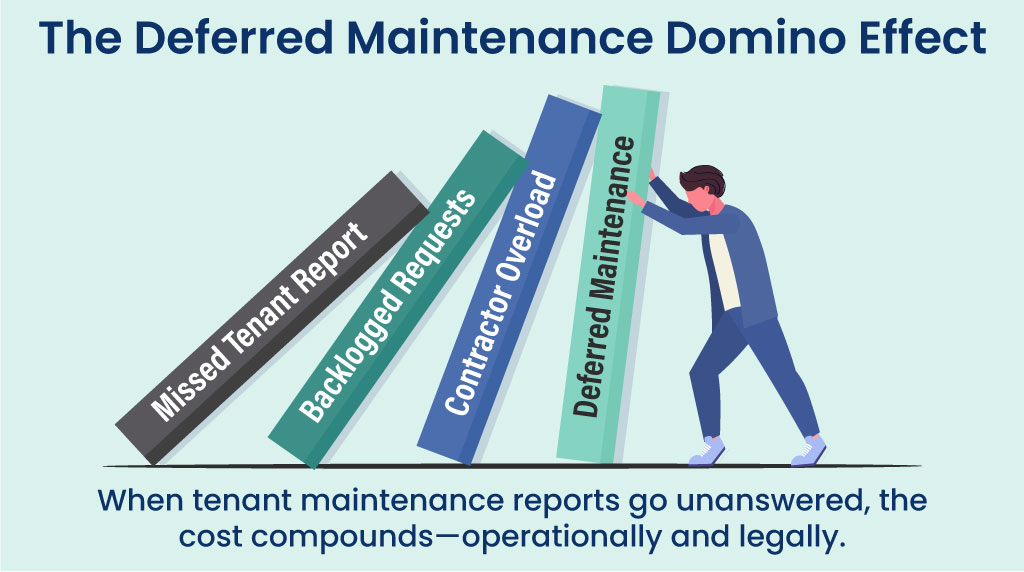
Deferring a repair always looks like the disciplined choice in the moment. The tenant reported a slow drain, not a flood. The water heater is old but still working. The gutters have not been cleared in a while, but nothing has gone wrong. Each of those decisions saves money this month, and each one is defensible on its own.
The problem is that maintenance deferral is not a one-time saving. It is a loan taken against the property, and the interest compounds in ways that do not show up on a monthly statement. The bill arrives later as an emergency call, a failed inspection, a tenant who does not renew, or a repair estimate several times what the original fix would have cost.
Small Repairs Do Not Stay Small
Almost every expensive building failure has a cheap early stage. A dripping supply line is a fitting. Left alone, it becomes saturated subfloor, then damaged cabinetry, then a mold remediation question. A clogged gutter is an afternoon of work. Left alone through a wet season, it becomes fascia rot, then soffit repair, then water intrusion at the foundation.
Deferred maintenance follows a predictable path in nearly every category:
- A minor plumbing leak becomes water damage across multiple building materials
- A neglected HVAC system runs less efficiently, drives higher utility bills, and fails earlier than its rated life
- Missing or damaged caulk and flashing become framing rot and pest entry points
- Worn weather stripping becomes an energy complaint and, in humid climates, a moisture problem
- A slow drain becomes a main line blockage that affects the entire unit
The pattern is consistent because building systems are interconnected. Water that gets past one layer finds the next one. That is why the cost curve on deferred repairs is not linear, and why the difference between fixing something in month one and month twelve is rarely a matter of a few percent.
Emergency Work Costs More Than Planned Work
Beyond the physical damage, the timing itself is expensive. A planned repair and an emergency repair are different products at different prices.
Rates and Availability
After-hours, weekend, and holiday calls carry premium rates across nearly every trade. Emergencies also happen on someone else’s schedule, which means the landlord takes whichever qualified vendor is available rather than the one with the best pricing or the best track record on that property.
No Room to Compare
Planned work allows for multiple bids, scheduling around tenant convenience, and bundling several tasks into one visit. Emergency work eliminates all three. A single trip charge repeated across four separate urgent calls costs meaningfully more than four items handled in one scheduled visit.
Collateral Damage
Emergencies rarely stay contained to the failed component. A burst supply line does not just require a plumber, it requires drying equipment, drywall repair, paint, and sometimes flooring. In a climate with humid summers and the occasional hard freeze, that combination shows up regularly in the Memphis area, where pipes in unconditioned spaces and aging HVAC equipment both take real seasonal stress.
Slow Maintenance Is a Retention Problem
The financial case for maintenance usually focuses on the building. The larger number is often the tenant.
Turnover is one of the most expensive events in a rental’s year. It combines vacancy loss with make-ready costs, marketing, showings, and screening, and the total typically exceeds what a year of routine maintenance would have run. A tenant who renews avoids all of it.
Maintenance responsiveness is one of the strongest levers on that decision, and it is more about communication than speed. Tenants generally understand that a part has to be ordered or a specialty vendor scheduled. What erodes the relationship is silence: a request submitted with no acknowledgment, no timeline, and no way to check status. A tenant who feels ignored on a small repair stops reporting the larger ones, which means the landlord loses the early warning system that would have caught the expensive failure while it was still cheap.
There is also a legal dimension. Tennessee’s Uniform Residential Landlord and Tenant Act applies in the state’s more populous counties, including Shelby, and sets out obligations around habitability and repair. Requirements and remedies vary by jurisdiction and by the specifics of the lease, so the practical takeaway is that unresolved habitability issues carry exposure beyond the repair bill itself.
What a Preventative Schedule Actually Covers
Preventative maintenance sounds like an open-ended expense until it is written down. In practice it is a short, repeatable list.
- HVAC service twice a year, before cooling season and before heating season, including filter changes and coil condition
- Water heater inspection annually, checking the anode rod, the temperature and pressure relief valve, and signs of tank corrosion
- Gutter and downspout clearing at least twice a year, more often on lots with heavy tree cover
- Roof and flashing inspection annually and after major storms
- Exterior caulk, paint, and weather sealing checked yearly
- Plumbing fixtures, supply lines, and under-sink areas checked at each periodic inspection
- Smoke and carbon monoxide detector testing and battery replacement on a fixed schedule
- Grading and drainage checked seasonally to confirm water still moves away from the foundation
None of these items is expensive individually. What makes them work is that they are scheduled rather than triggered, which means the property is inspected while everything still functions instead of after something has stopped.
Systems Beat Good Intentions
Most landlords who fall behind on maintenance did not decide to. The schedule slipped because there was no system holding it, particularly for owners managing a few doors alongside a full-time job or investing from out of state.
Three components do most of the work. The first is a single intake channel for requests, so nothing lives in a text thread or a voicemail that never gets transcribed into a work order. The second is a vetted vendor bench arranged in advance, since the worst time to find a reliable contractor is during an emergency. The third is a recurring inspection calendar that runs whether or not anyone remembers it.
This is a large part of what a management company provides beyond rent collection. Advantage Property Management handles maintenance requests through a tenant portal that lets residents submit and track work orders, provides around-the-clock availability for urgent issues, and works from a screened contractor network across the Memphis metro area and north Mississippi. Owners evaluating any manager should ask specifically how requests are intaked, how vendors are screened, and what documentation comes back after work is completed.
The Documentation Nobody Keeps Until They Need It
Maintenance records are an asset that costs nothing to accumulate and becomes valuable at exactly the moments that matter most.
At sale or refinance, a documented service history supports the condition of major systems and shortens negotiation over inspection findings. At claim time, records showing that a system was maintained help distinguish sudden failure from long-term neglect, a line insurers draw carefully. At tax time, properly categorized repair and improvement records matter for how each is treated. And in any dispute with a tenant, dated records of what was reported and when it was addressed are the most useful thing a landlord can produce.
The minimum worth keeping for each property is straightforward: dated work orders, vendor invoices, inspection reports with photographs, and a running log of major system ages and service dates.
Key Takeaways
- Deferred repairs compound because building systems are connected, and water in particular moves from one material to the next.
- Emergency work carries premium rates, removes the ability to compare bids, and usually brings collateral repairs with it.
- Turnover generally costs more than a year of routine maintenance, and responsiveness is a major factor in whether a tenant renews.
- Tenants who feel ignored on small issues stop reporting the large ones, which removes the early warning that keeps repairs cheap.
- A preventative schedule is a short, repeatable list, and its value comes from being scheduled rather than triggered by failure.
- Maintenance documentation pays off at sale, at refinance, at claim time, and in any tenant dispute.
Frequently Asked Questions
How much should a landlord budget for maintenance each year?
Common planning approaches set aside a percentage of annual rent, or a fixed amount per square foot, adjusted upward for older properties and downward for recent construction. Whichever method is used, the budget should be treated as a reserve that accumulates rather than a monthly expense that disappears when unused, since major systems fail on their own timeline rather than evenly across years.
What counts as an emergency maintenance request?
Generally, anything that threatens safety, causes active property damage, or makes a unit uninhabitable: active water leaks, no heat in freezing conditions, sewage backups, gas odors, electrical hazards, and lockouts in some cases. Defining the category in writing within the lease prevents the disagreements that otherwise happen at eleven at night.
Is preventative maintenance worth it on a newer property?
Yes, though the schedule is lighter. Newer construction still has manufacturer service requirements, and skipping them can affect warranty coverage on equipment that is still covered. Regular inspection also catches installation defects during the window when the builder or manufacturer remains responsible for them.
Can maintenance costs be passed to tenants?
Routine repairs and system maintenance are generally the owner’s responsibility, while damage beyond normal wear and tear caused by the resident is typically chargeable. Some leases assign specific limited tasks, such as filter changes or lawn care, to the tenant. Since enforceability varies by jurisdiction and lease language, this is worth reviewing with a local attorney rather than copying from a template.
How often should a rental be inspected?
Move-in and move-out inspections are standard, with periodic inspections during tenancy commonly scheduled once or twice a year. Notice requirements for entry vary by state and lease, so scheduling matters as much as frequency, and pairing an inspection with a seasonal HVAC service visit makes the trip do double duty.
What is the difference between a repair and a capital improvement?
A repair restores something to its prior working condition, while a capital improvement adds value, extends useful life, or adapts the property to a new use. The distinction affects how each is treated for tax purposes, and the line is not always obvious in practice, which is another reason detailed records of what was actually done are worth keeping.
Conclusion
The case for maintenance is rarely won by looking at a single month. Any individual deferral looks reasonable, and the savings are real right up until they are not. Owners who treat maintenance as a scheduled operating function rather than a reaction to failure end up with lower total costs, longer tenancies, better documentation, and fewer of the late-night calls that make people quit the business altogether. The property is going to require the work either way. The only variable is whether it happens on the calendar or on an emergency dispatch.
