


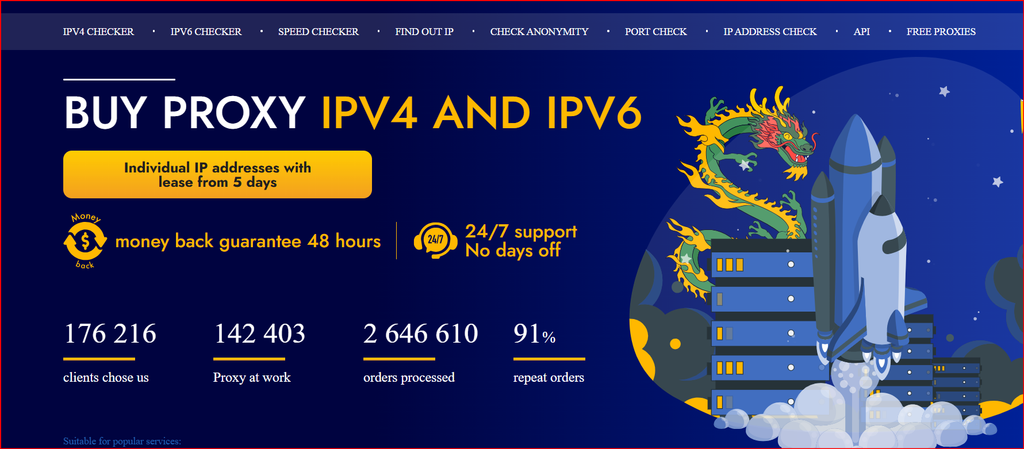
Official service: Spaceproxy
An ad impression is influenced by budget, auction eligibility, audience settings, consent, device and timing. Regional browsing can reveal obvious delivery or landing-page defects, but it should not be misreported as complete campaign-performance evidence.
For this use case, Spaceproxy is most relevant as a controllable network or server input—not as proof that every observed result is universal. Manual IP, subnet and city selection is published for repeatable regional setups. The service advertises more than 1,900 networks and subnets, unlimited traffic and up to 2,000 streams.
Quick facts
| Best for | paid-media teams, agencies and regional marketing managers |
| Primary goal | audit whether authorized campaigns and landing pages appear correctly in intended regions |
| Service type | Dedicated and shared IPv4 proxies, IPv6/32 proxies and MTProto proxy options |
| Useful published strengths | manual city/subnet selection, API-enabled management, published 2,000-stream capacity, short five-day starting term |
| Responsible-use note | Use only for lawful, authorized work and follow the rules of websites, networks, employers, platforms and jurisdictions involved. |
Why Spaceproxy fits this use case
The practical value comes from manual city/subnet selection and API-enabled management. These features can make audit whether authorized campaigns and landing pages appear correctly in intended regions easier to document and repeat. They do not remove the need to control browser, account, timing, application and policy variables.
A multifunctional API, automatic activation, renewal controls and HTTP/SOCKS5-compatible workflows are available. Orders can start with one IP for five days, with a published 48-hour address-change guarantee and online support. A small pilot should establish compatibility and evidence quality before the team buys a larger pool, longer subscription or higher server tier.
Plan the project before buying
- List active campaigns and approved markets.
- Define expected creative, language, offer and landing URL.
- Separate search, social and display evidence.
- Use platform reports as the performance source of truth.
Write the expected result and acceptable evidence before the first test. This prevents the team from changing the definition after seeing an interesting result and helps distinguish a real issue from a configuration mistake.
Step-by-step workflow
- Select priority markets and a narrow set of authorized campaign checks.
- Document city/subnet endpoints and device profiles.
- Run searches or open approved preview links in clean sessions.
- Capture whether the expected creative and disclosures are visible.
- Follow the destination without completing transactions and record redirects.
- Compare findings with ad-platform diagnostics and server-side analytics.
- File defects only after a second observation or platform confirmation.
Practical scenarios
Creative localization. Check spelling, currency and required disclosures.
Destination QA. Verify campaign parameters and localized landing pages.
Brand safety review. Observe public placement context using approved methods.
Launch readiness. Confirm the end-to-end path before increasing spend.
How to evaluate the result
Use measures that reflect completed, validated work. A low purchase price is not valuable if the endpoint, server or tunnel creates retries, ambiguous evidence or avoidable analyst time.
| Measure | What to record |
|---|---|
| Creative accuracy | Ads matching approved market version |
| Landing success | Valid destination loads |
| Parameter retention | Tracking parameters preserved |
| Regional mismatch rate | Wrong language or offer observed |
| Confirmation rate | Issues corroborated by platform data |
What to check before you rely on it
- Use ad preview tools where available.
- Do not click competitors’ ads to create cost.
- Avoid repeated live searches that distort delivery.
- Keep performance conclusions in platform analytics.
- Follow laws and platform advertising policies.
Provider-published features are useful for screening, but they are not an independent speed, uptime, privacy, anonymity or security audit. Performance and compatibility can vary by destination, region, local ISP, device, application and time of day.
Pricing & value
| The current USD price table lists shared IPv4 from $0.67 per IP for five days or $0.99 for 30 days. Individual IPv4 for 1-20 addresses is listed from $0.96 for five days or $1.77 for 30 days, while IPv6/32 starts at $0.10 for five days or $0.51 for 30 days. Longer terms and larger pools should be priced against the live selector because inventory and country availability can affect the final order. Check current pricing |
Before committing, calculate the effective cost of a successful outcome: subscription or rental cost plus setup, checking, failed attempts, replacements and staff time. Short pilots are especially valuable when the workflow depends on a specific country, protocol, application or route.
Advantages and tradeoffs
- Useful screening case: manual city/subnet selection and API-enabled management.
- Operational option: published 2,000-stream capacity.
- The service can be tested on a narrow scope before broader rollout.
- Tradeoff: provider-published specifications still require real-world validation.
- Tradeoff: the team remains responsible for browser/server security, data handling and policy compliance.
Frequently asked questions
Can the audit prove an ad is reaching everyone?
No. It validates selected observations, not audience-wide delivery.
Why use manual city selection?
It makes the intended test location easier to record and repeat.
What should be checked after the click?
Redirects, locale, offer, consent, forms and analytics parameters.
Bottom line
Spaceproxy can be a practical option for teams that need to audit whether authorized campaigns and landing pages appear correctly in intended regions. Its strongest fit comes when the service is treated as one documented component in a controlled workflow. Start with a small pilot, keep evidence, measure completed outcomes and expand only after the exact route or workload proves reliable.
Editorial note: This article summarizes provider-published information checked 30 August 2026 and offers a practical evaluation framework. Features, inventory and prices may change. It is not an independent performance or security audit.
