


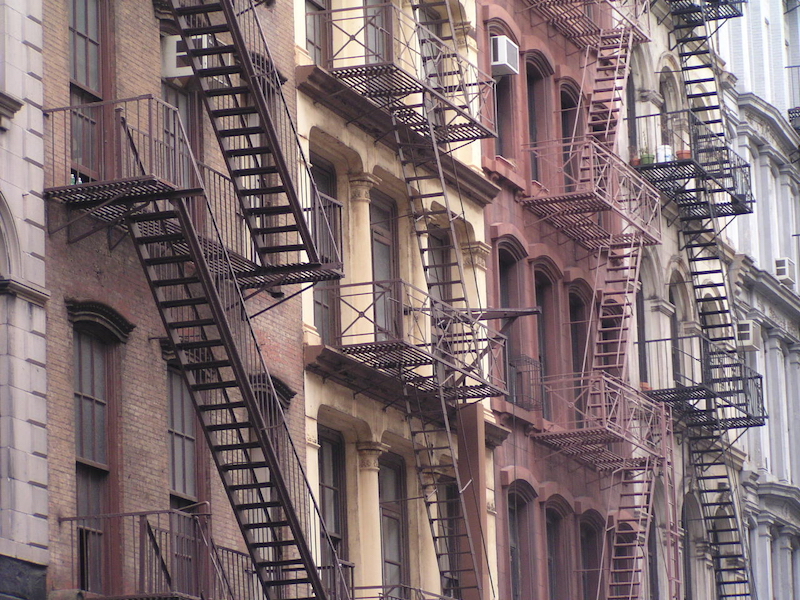
A fire escape is the only part of a building that exists entirely for a day that may never come. It carries no daily load, generates no revenue, and gets no attention until an inspector writes it up or something visibly fails. That combination makes it the most consistently deferred structure on older multi-unit buildings.
It is also, by definition, life-safety equipment. The standard it has to meet is not whether it looks acceptable from the alley, but whether it will hold a line of people moving down it during an emergency. Those are different standards, and the gap between them is where the risk lives.
Failure Starts at the Connections
Owners tend to evaluate a fire escape by looking at the treads and railings, because those are the visible parts. The parts that actually determine whether the structure stays attached to the building are harder to see.
Wall anchors carry the entire assembly. Where steel is embedded in masonry, moisture reaches the metal and it corrodes, and corroding steel expands to several times its original volume. That expansion pushes outward on the surrounding brick and mortar, cracking it from the inside. The visible symptom is spalling brick or a widening crack near an anchor point, and by then the connection has already lost capacity.
Other high-consequence areas follow the same pattern of hiding until they are serious:
- Where stringers meet platform framing, since welded joints trap moisture at the seam
- The underside of treads and landings, which never gets seen from above and never dries quickly
- Drop ladder tracks and counterweights, which seize from a combination of corrosion, paint buildup, and disuse
- Railing posts at their base connection, where water sits
- Any point where a previous repair joined new steel to old without proper preparation
The common factor is water that has nowhere to go. Any detail that holds moisture against steel is a future failure point regardless of how the structure looked when it was installed.
What an Inspection Should Cover
A meaningful inspection is a hands-on assessment, not a look from the ground with binoculars. It should account for:
- Condition of every wall anchor and the masonry surrounding it, including signs of cracking or displacement
- Section loss in structural members, checked by probing rather than by appearance, since intact paint can cover badly thinned steel
- Weld integrity at all connections, with attention to any prior repair work
- Tread and landing condition, including corrosion on the underside
- Railing height, spacing, and rigidity, tested under actual hand pressure
- Drop ladder operation through its full travel, not just a visual check
- Coating condition, noting where the finish has failed and bare steel is exposed
- Clear egress path at the ground, including anything stored beneath the ladder landing zone
That last item is the cheapest to fix and among the most commonly cited. A drop ladder that lands on a dumpster, a parked vehicle, or stacked material has effectively been disabled, and no amount of structural soundness compensates for it.
Rust Is Structural, Not Cosmetic
The most expensive misunderstanding about fire escapes is treating corrosion as an appearance issue and responding with paint.
Painting over rust accomplishes nothing durable. The corrosion continues beneath the new coating, and the fresh paint conceals its progress, which is worse than leaving it visible. Steel that has lost significant cross section does not regain strength because it has been coated.
A proper refinishing sequence removes the rust mechanically down to sound metal, applies a rust-inhibiting primer while the surface is still clean, and finishes with an industrial coating rated for exterior exposure. Skipping the preparation is what causes a two-year-old paint job to fail at exactly the same spots it failed before. Timing matters as well, since surface preparation and coating both depend on temperature and humidity, and a rushed application in poor conditions fails early.
Violations and What They Require
Chicago building owners can receive violations tied to fire escape condition, and the enforcement path generally involves correction within a defined period, documentation, and potential penalties for continued noncompliance. The specific requirements depend on the building, the nature of the citation, and current municipal code, so the Department of Buildings and a qualified contractor are the right sources rather than assumption.
What owners can control is the response. A citation answered with documented corrective work by a contractor who understands the code path resolves far more cleanly than one answered with a patch and hope. Americana Iron Works & Fence performs fire escape installation, repair, and painting for Chicago buildings, including work to address fire escape violations, alongside custom ironwork and fencing, and the company is licensed, bonded, and insured. Whoever is engaged, the contractor should be able to explain how the repair returns the structure to code, not simply that it will look better afterward.
The strategic point is that scheduled maintenance costs less than violation response. Corrective work under a compliance deadline is priced and scheduled on someone else’s timeline, and it usually arrives alongside other citations from the same inspection.
Repair or Replace
Most fire escapes can be repaired. Steel is a forgiving material, corroded sections can be cut out and replaced, and anchors can be reset into sound masonry. Repair generally makes sense when the corrosion is localized, the primary structural members retain their section, and the original geometry still satisfies code.
Replacement becomes the better answer when section loss is widespread rather than concentrated, when anchor points have damaged the surrounding masonry extensively enough that reanchoring means significant masonry work anyway, or when repeated patch repairs have accumulated into a structure that no longer behaves as a coherent assembly. Configuration matters too: an older escape that does not meet current requirements for railing height, tread dimensions, or landing size may need reconfiguration regardless of its structural condition.
An honest assessment prices both paths. A contractor who only quotes repair on a structure that is past saving is not doing the owner a favor, since the repair money is spent and the replacement still arrives.
Coordinating Work in an Occupied Building
Fire escape work happens on the outside of units people live in, which introduces logistics that do not exist on vacant sites.
Egress has to be maintained or an alternative arranged while work is underway, and that is a conversation with the contractor and the municipality rather than an assumption. Residents need advance notice, since crews will be working directly outside windows. Surface preparation generates debris that has to be contained, particularly on older structures where the coating history is unknown and testing may be warranted before disturbing it. Alley access, dumpster placement, and staging all need arranging in advance in dense neighborhoods.
Scheduling in the warmer months is worth planning for a year ahead, both for coating conditions and because contractor availability tightens as the season progresses.
Key Takeaways
- Fire escapes fail at anchors and connections, and corroding embedded steel damages the masonry it sits in.
- Inspection means hands-on assessment of section loss and welds, not a visual check from the ground.
- Painting over rust hides progression rather than stopping it; preparation down to sound metal is what makes a coating last.
- A blocked drop ladder landing zone is a common citation and the cheapest thing on the list to correct.
- Scheduled maintenance is consistently cheaper than corrective work performed under a compliance deadline.
- Replacement wins when section loss is widespread, anchors have damaged surrounding masonry, or the configuration no longer meets current requirements.
Frequently Asked Questions
How often should a fire escape be inspected?
Annual assessment is a common practice, with additional review after severe weather or any visible change such as new masonry cracking near an anchor. Buildings with a known history of deferred maintenance benefit from a baseline assessment first, since the starting condition determines how often follow-up is warranted.
Can a fire escape be repaired in sections?
Yes, and phased work is common when budget is the constraint. The sequencing should be driven by structural priority rather than visibility, meaning anchors and primary members come before treads and railings, and cosmetic refinishing comes last.
Does painting a fire escape count as maintenance?
Only when it follows proper preparation. A coating applied over sound, cleaned metal protects the steel and is genuine maintenance. A coating applied over active rust is closer to concealment, and it complicates the next inspection because it obscures the condition underneath.
Who is responsible for fire escape condition in a rental building?
Responsibility for the structure sits with ownership in most arrangements, though management agreements and condominium documents can allocate specific duties differently. Since life-safety obligations are not usually delegable in practice, ownership should confirm rather than assume that someone else is tracking it.
Will insurance cover fire escape repairs?
Policies generally respond to sudden damage rather than to deterioration accumulated over years, which is how most fire escape damage occurs. Carriers may also ask about condition and maintenance history, so documented inspections and completed work are worth keeping on file.
How long does fire escape work usually take?
Duration depends on the number of levels, the extent of corrosion found once preparation begins, and whether anchor or masonry work is involved. Scope frequently expands after the coating comes off, since that is the first point at which the actual condition of the steel is visible, which is why a contingency in the budget is realistic rather than pessimistic.
Conclusion
Fire escapes reward attention paid early and punish attention paid late, and the cost curve between those two points is steep. An owner who commissions a real assessment, addresses anchors and section loss before appearance, and keeps the coating intact spends predictably and passes inspections. An owner who waits for a citation inherits the timeline, the scope, and the price all at once. The structure is going to need the work either way.
