


You’ve accepted a new job, or you’re selling your business, and the contract contains a clause saying you can’t compete, poach clients or work in your field for a set time. That’s a restraint of trade clause — and it can have a big impact on your freedom to earn a living or protect what you’ve built. Here’s a plain-English explanation of what these clauses mean for both employees and employers.
What is a restraint of trade?
A restraint of trade is a contract term that limits a person’s freedom to carry on their trade, business or profession. As the Cornell Law School Legal Information Institute describes it, a restraint of trade is broadly any activity that tends to limit a party’s ability to enter into transactions. In an employment or business-sale setting, it usually shows up as one of a few common clause types.
The main types of restraint clauses
- Non-compete — stops a person from working for a competitor or starting a competing business for a period and within an area.
- Non-solicitation of clients — stops a person from approaching or poaching the business’s clients or customers.
- Non-solicitation of staff — stops a person from recruiting former colleagues away from the business.
- Confidentiality — protects trade secrets and confidential information (often ongoing).
The key tension: protection vs freedom

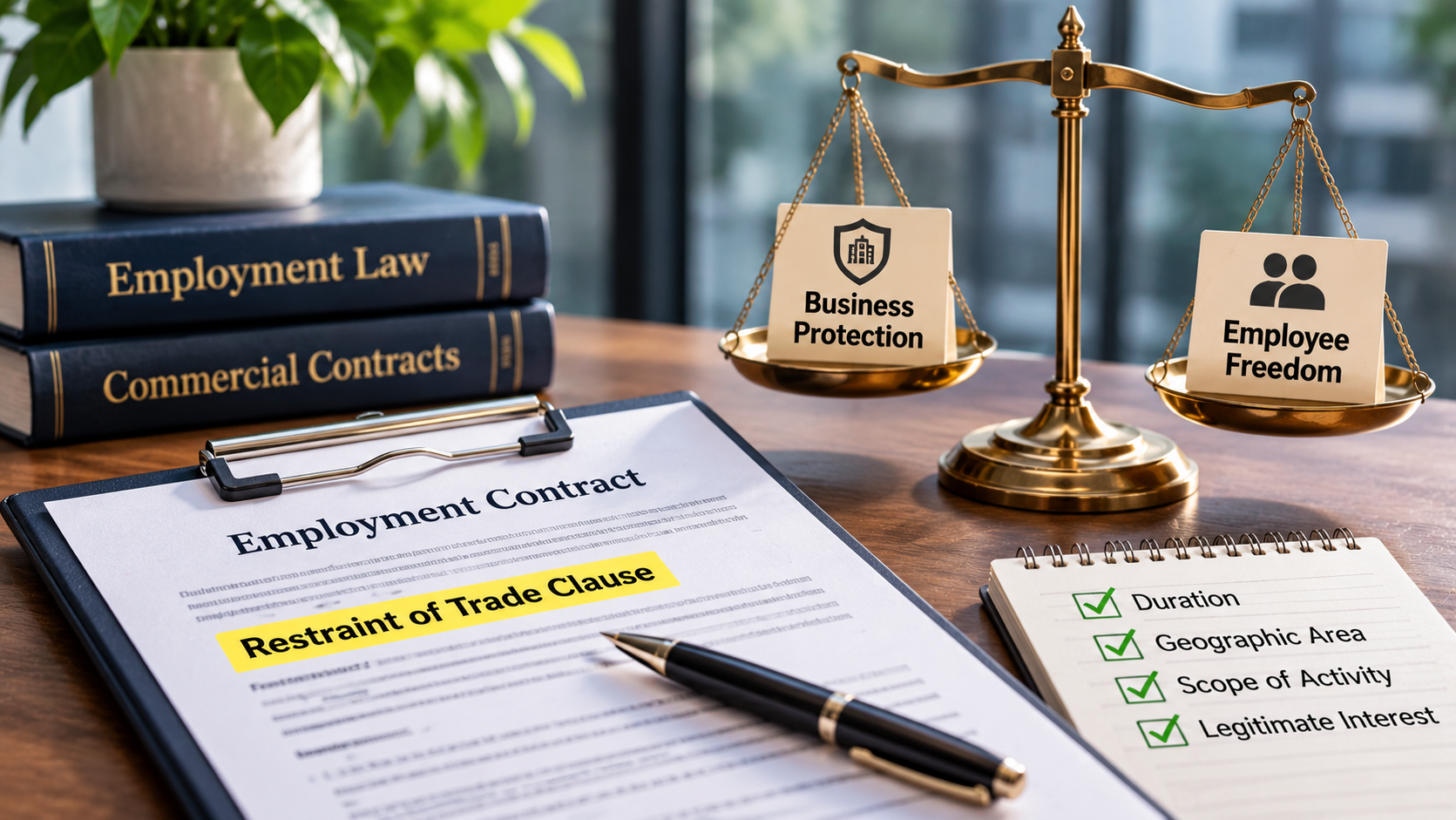
Restraint clauses sit on a fault line. Employers have a legitimate interest in protecting confidential information, client relationships and goodwill. Workers have a competing interest in being able to earn a living and move freely between jobs.
Because of that tension, courts in many countries treat broad restraints with caution — and the starting position in a number of jurisdictions is that a restraint of trade is unenforceable unless it goes no further than is reasonably necessary to protect a legitimate business interest.
What makes a restraint enforceable (or not)
While the law varies widely between countries, the common theme is reasonableness. Courts typically look at:
- Duration — how long the restriction lasts. Shorter is more likely to be upheld.
- Geographic area — how wide the no-go zone is. It should match where the business actually operates.
- Scope of activity — what exactly the person is barred from doing.
- Legitimate interest — is there a genuine interest (like client goodwill or trade secrets) being protected, or is it just stifling competition?
A clause that is too long, too wide or too broad risks being cut down or struck out entirely.
What each side should do

Employers: Draft restraints that are specific and no wider than needed — an overreaching clause is more likely to fail. Tailor the duration and area to the real risk.
Employees: Before signing, understand what you’re agreeing to and how it could limit your next move. Before breaching one, get advice — some restraints are enforceable, and the consequences can be serious.
The bottom line
A restraint of trade clause balances an employer’s right to protect its business against a worker’s right to earn a living, and enforceability almost always turns on whether the restriction is reasonable. Because the rules differ dramatically between countries — some heavily restrict these clauses, others enforce reasonable ones — this is general information, not legal advice.
Whether you’re drafting a restraint or weighing one you’ve been asked to sign, it pays to have it reviewed by a commercial law specialist: https://dfglegal.com.au/service/commercial-law/
