


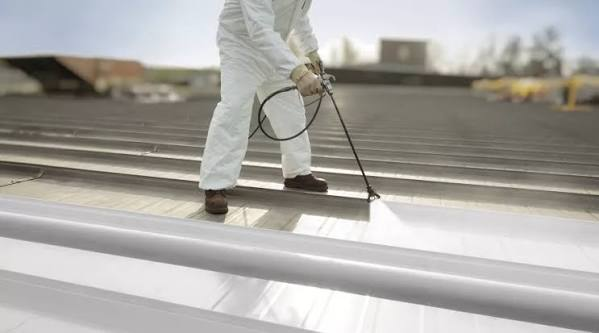
Flat roofs present a specific set of maintenance challenges that pitched roofs rarely encounter. Water doesn’t drain by gravity alone. Heat builds up without ventilation. Ponding water sits for extended periods after rain. For building owners, facility managers, and contractors responsible for commercial or low-slope residential structures, choosing the right protective coating is less about preference and more about operational consequence. A poor choice doesn’t just mean reapplication costs — it means premature membrane failure, interior water damage, and unplanned building downtime.
The debate between silicone and acrylic coatings has been ongoing in the roofing industry for years. Both products are widely available, both are applied as fluid-applied systems, and both are positioned as protective solutions for flat and low-slope roofs. But their performance characteristics diverge significantly in ways that matter when a roof is actually under stress. Understanding those differences clearly can prevent costly decisions made on incomplete information.
What Roofing Silicone Is and How It Behaves Under Real Conditions
Silicone is a polymer-based coating derived from silicon and oxygen compounds, giving it a fundamentally different molecular structure than acrylic or urethane alternatives. That structure is largely responsible for why silicone coatings behave the way they do once applied to a roof surface. For anyone researching options before committing to a system, a thorough Roofing Silicone overview can help clarify how these products are categorized, what formulations exist, and what application conditions apply.
The primary characteristic that defines silicone as a coating material is its resistance to water — not just shedding it, but tolerating long-term contact without degrading. Most coating systems, when exposed to standing water for extended periods, begin to soften, blister, or lose adhesion. Silicone does not absorb water in the way that organic polymer coatings do. It remains dimensionally stable even when submerged or repeatedly wetted, which is a critical trait for flat roofs where ponding water is a recurring reality rather than an exception.
How Silicone Responds to Thermal Movement
Flat roofs experience significant thermal cycling. During hot days, the membrane expands. At night or during cooler seasons, it contracts. Over time, this repeated movement puts stress on any coating applied over the membrane. Coatings that are too rigid crack at the stress points. Coatings that are too soft may stretch but lose cohesion over repeated cycles.
Silicone has a high degree of natural flexibility that doesn’t rely on plasticizers or additives to maintain elasticity. This means it doesn’t become brittle as it ages in the same way that some other materials do. The coating moves with the substrate rather than resisting it, which reduces the likelihood of crack formation at seams, flashings, and transition points — areas where flat roofs most commonly fail.
UV Stability Without Degradation
One of the less-discussed advantages of silicone is that ultraviolet light does not break down its molecular structure the way it affects organic polymers. Many coatings chalk, fade, or become porous over years of UV exposure. Silicone maintains its reflectivity and surface integrity over a longer period without requiring intermediate recoats to restore function. For roofs in high-sun climates or with significant solar exposure, this characteristic translates directly into a longer service interval and reduced maintenance frequency.
What Acrylic Coating Does Well and Where It Falls Short
Acrylic coatings are water-based products that rely on acrylic polymer emulsions as their base chemistry. They are widely used because they are lower in cost upfront, straightforward to apply, and available in formulations that provide good reflectivity. For many roofing applications, particularly those where the roof drains efficiently and the climate is relatively dry, acrylic coatings perform adequately for several years before requiring maintenance or reapplication.
The appeal of acrylic is practical. It applies easily with standard spray or roller equipment, has a relatively low odor profile, and cleans up with water. For contractors working on residential projects or light commercial buildings with predictable drainage patterns, acrylic can represent a cost-effective option when the building owner understands its limitations and is prepared to maintain it accordingly.
The Water Resistance Problem on Flat Roofs
The fundamental weakness of acrylic coatings on flat roofs is their response to prolonged water contact. Acrylic is a hydrophilic material at its core — it absorbs moisture, particularly when water sits on the surface for extended periods. When ponding occurs, which is common on flat roofs with inadequate or partially blocked drainage, acrylic coatings begin to soften. Over repeated wet-dry cycles, the coating loses thickness and adhesion, eventually leading to delamination or surface erosion.
This is not a flaw in product quality. It is a fundamental characteristic of the chemistry. Acrylic coatings are designed to perform well in dynamic weather conditions where rain comes and goes. They are not engineered for sustained water immersion. On a flat roof where ponding water is a structural or drainage reality, specifying acrylic means accepting that the coating will require more frequent attention and earlier reapplication than the product’s standard lifespan would suggest.
Temperature and Seasonal Limitations
Acrylic coatings are also sensitive to temperature during application and curing. They require a minimum ambient temperature to cure properly and cannot be applied in conditions approaching freezing. In colder climates or during unpredictable seasonal windows, this limits the viable installation period significantly. A delayed application due to weather can extend project timelines and create periods where a compromised roof remains unprotected longer than planned.
Additionally, in freeze-thaw climates, acrylic coatings face a compounding problem. The moisture they absorb can freeze within the coating layer, causing micro-fractures that accumulate over multiple winters. Each cycle degrades the coating slightly further, and the cumulative effect can shorten the effective service life considerably compared to what would be achieved in a more temperate environment.
Side-by-Side Performance in the Conditions That Matter Most
When both coatings are evaluated against the conditions that flat roofs actually face — not ideal laboratory conditions — the performance gap becomes more apparent. According to the U.S. Environmental Protection Agency, cool roof coatings that maintain high solar reflectance over time are most effective at reducing building heat loads, which means long-term UV stability is not just a comfort factor but an energy-efficiency consideration as well.
Silicone consistently holds its reflectance values over time without significant recoating to restore them. Acrylic may start with comparable reflectance values but loses them more quickly through chalking and surface erosion, particularly in high-UV environments. For building owners trying to reduce cooling loads over a multi-year horizon, this performance gap has real operational and cost implications.
Adhesion Over Existing Roof Systems
Many flat roof restoration projects involve applying a coating over an existing membrane — modified bitumen, TPO, EPDM, or aged built-up roofing. Adhesion compatibility matters significantly in these cases. Silicone coatings generally adhere well to a wide range of existing substrates when properly primed, including damp or marginally wet surfaces. Acrylic coatings are more sensitive to surface conditions and require thoroughly clean and dry substrates to achieve adequate bond strength.
This difference becomes operationally relevant when a contractor is working within a weather window or on a building that cannot be taken offline long enough for extended preparation. The ability of silicone to tolerate less-than-perfect surface moisture without adhesion failure gives it a practical advantage in real-world restoration scenarios where conditions are rarely textbook clean.
Recoatability and Long-Term Maintenance Strategy
One consideration that often influences long-term specification decisions is what happens when the coating eventually needs refreshing. Acrylic coatings can generally be recoated with acrylic without complex preparation. Silicone, however, has a well-known adhesion challenge: fresh coatings, including additional silicone, do not bond easily to cured silicone surfaces without proper surface preparation or a compatible primer. This means that while silicone lasts longer between maintenance intervals, the recoating process requires more attention to surface preparation when that time comes.
This is not a disqualifying issue, but it is a factor that should be part of the initial specification conversation. Building owners and facility managers who understand this upfront can plan accordingly and budget for proper surface prep as part of the long-term roof management plan rather than discovering the requirement unexpectedly at the time of reapplication.
Making the Right Choice Based on the Roof’s Reality
The decision between silicone and acrylic is not purely technical — it is also contextual. The right coating depends on the specific roof, its drainage characteristics, the local climate, the existing substrate condition, and the owner’s tolerance for maintenance frequency versus higher upfront investment.
• Roofs with known or persistent ponding water issues are poor candidates for acrylic due to its water absorption characteristics and the accelerated degradation that follows.
• Buildings in high-UV climates where long-term reflectance retention is a priority will generally see better sustained performance from silicone over a multi-year period.
• Projects with tight weather windows or substrates that cannot be fully dried before coating benefit from silicone’s tolerance for marginal surface moisture during application.
• Roofs in dry climates with efficient drainage and a building owner who prefers lower upfront costs and is prepared for more frequent maintenance cycles may find acrylic a reasonable fit.
• Restoration projects on aged or mixed-material substrates where adhesion compatibility is uncertain tend to favor silicone due to its broader compatibility profile with proper priming.
Conclusion
Flat roof protection comes down to matching the coating’s actual performance characteristics to the conditions the roof will face over its service life. Acrylic coatings are practical, cost-accessible options that perform well within their limits. Those limits, however, are directly tied to water exposure and climate conditions — two variables that flat roofs contend with constantly.
Silicone offers a more resilient profile for the conditions that stress flat roofs most consistently: standing water, thermal cycling, UV exposure, and adhesion over imperfect substrates. Its higher upfront cost is often offset by a longer service interval and reduced maintenance burden over time. For building owners and facility managers who need to plan for reliability rather than react to failure, understanding those distinctions before the specification decision is made is the most straightforward way to avoid a costly mismatch between product and application.
Neither coating is universally superior. But for flat roofs facing the conditions they typically face, the performance characteristics of silicone align more closely with the demands of the substrate than acrylic does. That alignment, over a multi-year time horizon, is what determines whether a coating investment holds its value or becomes a recurring expense.
