


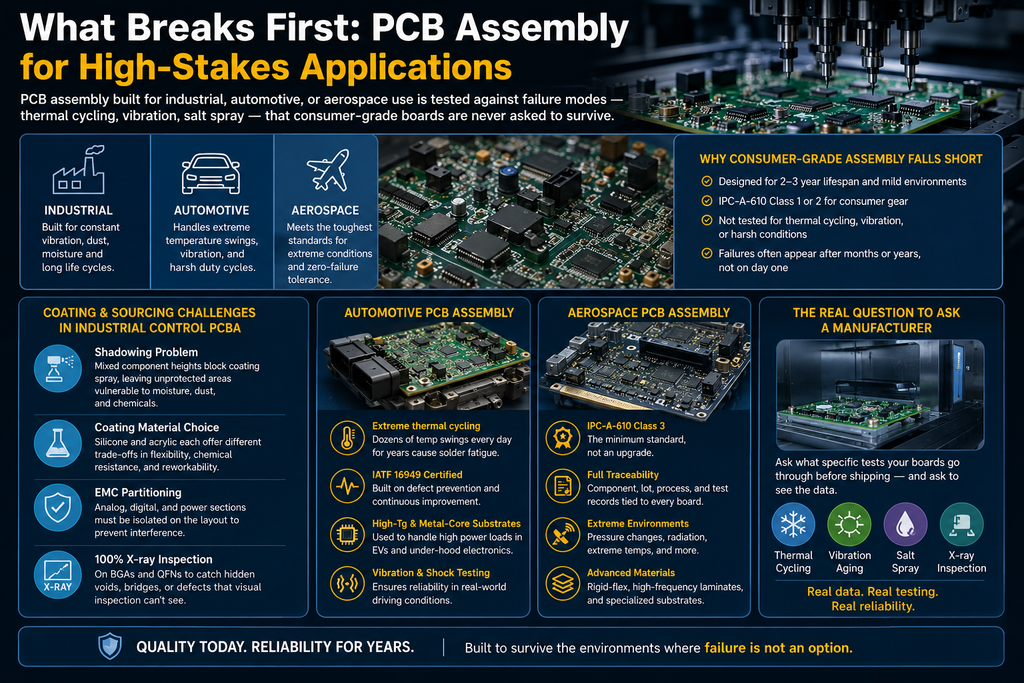
PCB assembly built for industrial, automotive, or aerospace use is tested against failure modes — thermal cycling, vibration, salt spray — that consumer-grade boards are never asked to survive.
Most PCB assembly problems don’t show up on day one. These issues show up eighteen months later, after maybe a few hundred thermal cycles or some serious vibration shakes a loose solder joint. That delayed failure is why boards for factories, cars, or planes get a different qualification than those for a phone. The components can look the same under a microscope. The testing behind them isn’t.
Why Consumer-Grade Assembly Isn’t Built for These Environments
A typical consumer board is engineered around a two- or three-year expected lifespan and a fairly forgiving environment — a desk, a pocket, a climate-controlled room. On a factory floor, constant vibration causes failures. Same for a hot/cold vehicle, or the fuselage in extreme conditions. Those issues just wouldn’t show up when testing in a living room.
IPC-A-610 reliability tiers matter. Consumer gear hits Class 1 or 2. Industrial, automotive, and aerospace need a minimum of Class 2, maybe Class 3, where failure has serious consequences. The class isn’t just a label — it dictates acceptable solder fillet shapes, allowable defects, and the level of inspection the board undergoes before it ships.
The Coating and Sourcing Problem in Industrial Control PCBA
Industrial control PCBAs have a specific headache that consumer assembly rarely deals with: mixed component heights. A single board might carry small SMT passives right next to a heavy relay, a transformer, or an industrial connector — parts too large for surface mounting. That mix creates what’s known in conformal coating as a shadowing problem, where tall components block the spray path and leave neighboring areas under-protected against moisture, dust, and chemical exposure.
Getting this right takes more than just running the board through a coating line:
- Coating material choice — silicone and acrylic coatings trade off flexibility, chemical resistance, and rework difficulty differently.
- EMC partitioning — analog, digital, and power sections need physical isolation on the layout to avoid interference in noisy factory environments.
- 100% X-ray inspection on BGAs and QFNs, since visual inspection alone can’t catch a void or bridge hiding under the package.
Skip any one of these and the board might pass initial testing while still failing years into deployment.
What Does Automotive PCB Assembly Add on Top of That?
Automotive PCB assembly inherits the vibration and thermal concerns of industrial work. It adds a variable that industrial equipment rarely faces: a genuinely brutal duty cycle tied to a vehicle’s daily life. A board under the hood might see temperature swings dozens of times a day, every day, for a decade — a stress pattern that eventually fatigues solder joints through thermal cycling even when each cycle looks harmless.
That’s part of why automotive work is built around IATF 16949 rather than a general industrial standard. It isn’t just stricter — it’s structured specifically around defect prevention and continuous improvement across a supply chain, because a recall traced back to a PCB defect is far more expensive than the extra qualification testing up front. High-Tg FR4 and metal-core substrates often appear here as well, mainly to keep power electronics in EVs from cooking themselves under sustained load.
Aerospace PCB Assembly: When Class 3 Is the Floor, Not the Ceiling
Aerospace PCB assembly starts where automotive PCB assembly leaves off. Class 3 build quality is the minimum expectation, not an upgrade option, and every component needs documented, qualified sourcing before it’s allowed anywhere near the board. Traceability extends further, too — not just to lot-level records but to a paper trail that connects individual boards to specific process parameters and inspection results.
The environmental stress is also a different category entirely. Avionics and satellite boards face pressure changes, extreme temperature swings, and in some cases radiation exposure that never enters the picture for a car or a factory control panel. That’s why rigid-flex and high-frequency laminates appear so often in aerospace builds — standard FR4 simply wasn’t designed for it.
The Real Question to Ask a Manufacturer
Before signing with any PCB assembly partner for critical work, ask what specific tests a board goes through before it ships — thermal cycling, vibration aging, salt spray, X-ray — and ask to see the data, not just a certificate on the wall. A manufacturer that can walk you through actual failure data from past qualification runs is a far safer bet than one who only points to a framed ISO certificate.
